Showing posts with label M-209. Show all posts

Thursday, July 11, 2024

The American M-209 cipher machine

At the start of WWII, the US armed forces used various means for enciphering their confidential traffic. At the lowest level were hand ciphers. Above that were the M-94 and M-138 strip ciphers and at the top level a small number of highly advanced SIGABA cipher machines.

The Americans used the strip ciphers extensively however these were not only vulnerable to cryptanalysis but also difficult to use.  Obviously a more modern and efficient means of enciphering was needed.

At that time Swedish inventor Boris Hagelin was trying to sell his cipher machines to foreign governments. He had already sold versions of his C-36, C-38 and B-211 cipher machines to European countries. He had also visited the United States in 1937 and 1939 in order to promote his C-36 machine and the electric C-38 with a keyboard called BC-38 but he was not successful (1). The Hagelin C-36 had 5 pin-wheels and the lugs on the drum were fixed in place. Hagelin modified the device by adding another pin-wheel and making the lugs moveable. This new machine was called Hagelin C-38 and it was much more secure compared to its predecessor.

In 1940 he brought to the US two copies of the hand operated C-38 and the Americans ordered 50 machines for evaluation. Once the devices were delivered, they underwent testing by the cryptologists of the Army’s Signal Intelligence Service and after approval it was adopted by the US armed forces for their midlevel traffic. Overall, more than 140.000 M-209’s were built for the US forces by the L.C. Smith and Corona Typewriters Company. (2)


The American version of the Hagelin C-38 was called Converter M-209 by the Army and USAAF and CSP-1500 by the Navy. Compared to the original version it had a few modifications. The M-209 had 27 bars on the drum while the C-38 had 29. Another difference was that the letter slide was fixed. During operation the text was printed by setting the letter spindle on the left to the desired letter and then turning the hand crank on the right.

The M-209 was a medium-level crypto system used at Division level down to and including battalions (Division-Regiment-Battalion) (3) and even up to Corps for certain traffic. The USAAF used it for operational and administrative traffic and the Navy aboard ships. SIGABA was used for higher level messages (Army-Corps-Division) and hand systems like Slidex and the Division Field Code used for tactical messages (Battalion-Company-Platoon).

The Germans called it ‘AM 1’ (Amerikanische Maschine 1) and the Japanese ‘Z code‘.

Sunday, January 6, 2019

Update

In The American M-209 cipher machine I added info on the unit NAASt 7 and the section:

Invasion of Sicily

In July 1943 US and British troops invaded the island of Sicily and after more than a month of fighting defeated the Axis forces and captured the island. However the German forces were able to avoid a total defeat by retreating in an orderly fashion through the Strait of Messina.

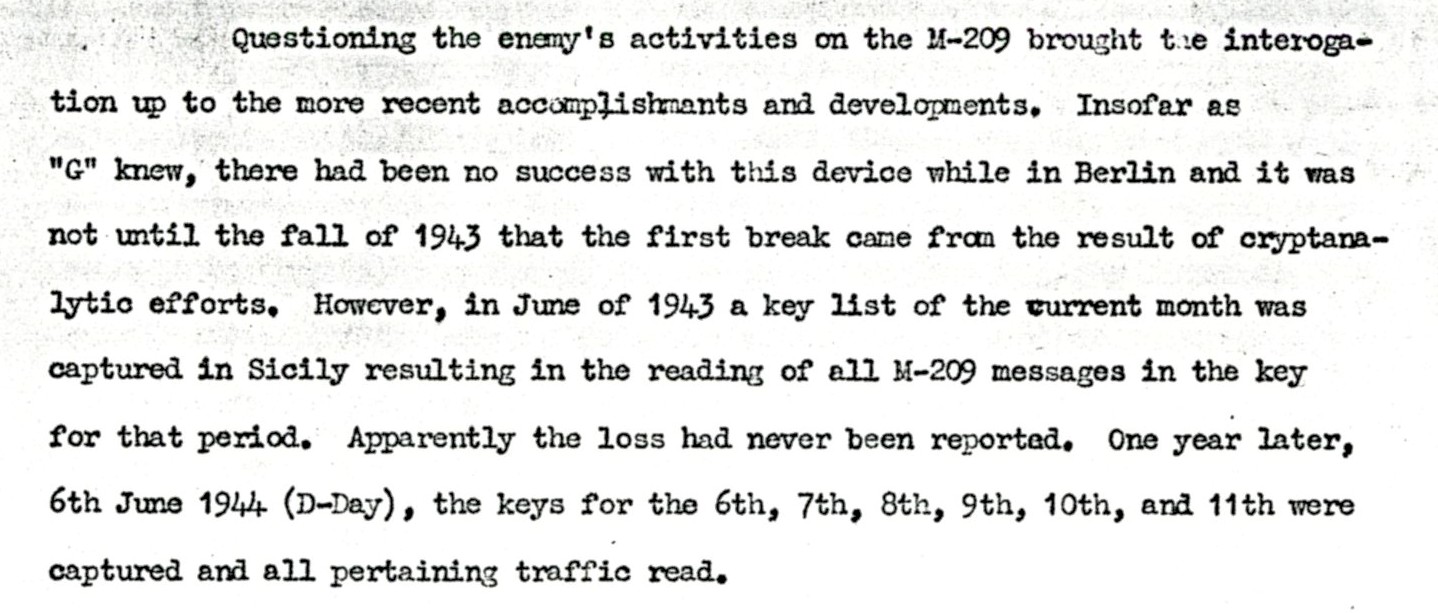
It seems that during the fighting in Sicily the Germans managed to capture a valid keylist of an M-209 network and thus read current US military traffic (14). 


The war diary of Inspectorate 7/VI says that in July ’43 the captured material allowed the continuous decryption of the traffic with indicator ‘ID’ and the results were communicated to NAAst 7.


The report of August ’43 says that messages of the ‘ID’ network could be decoded till mid month and after that it was still possible to find several cases of indicator reuse and thus solve the traffic of those days cryptanalytically.


Saturday, December 8, 2018

Reports on enemy successes against US cryptosystems

I have uploaded the file ‘Reports on enemy successes against US cryptosystems’.


The source was US National archives - collection RG457 - Entry 9032 - box 1.367 - NR 4263.

There is an interesting report in that file concerning the German exploitation of the US M-209 cipher machine in late 1944 and early 1945:


NA 7 Sigint HQ was the Signal Intelligence Evaluation Center of KONA 7 (Kommandeur der Nachrichtenaufklärung - Signals Intelligence Regiment) covering Italy.

According to TICOM report IF-272 only two reports of KONA 7 survived WWII. These were E-Bericht IV/44 and E-Bericht I/45.

Unfortunately I don’t know where to find them.

Thursday, November 29, 2018

Update

In the The American M-209 cipher machine I’ve added the following under ‘Additional information’:

M-209 vs Enigma:

Regarding the cryptologic strength of the M-209 machine versus the plugboard Enigma, the expert on classical cipher systems George Lasry (15) has stated:

One comment about the security of the M-209. The claim that the Enigma is more secure than the M- 209 is disputable.

1) The best modern ciphertext-only algorithm for Enigma (Ostward and Weierud, 2017) requires no more than 30 letters. My new algorithm for M-209 requires at least 450 letters (Reeds, Morris, and Ritchie needed 1500). So the M-209 is much better protected against ciphertext-only attacks.

2) The Turing Bombe – the best known-plaintext attack against the Enigma needed no more than 15-20 known plaintext letters. The best known-plaintext attacks against the M-209 require at least 50 known plaintext letters.

3) The Unicity Distance for Enigma is about 28, it is 50 for the M-209.

4) The only aspect in which Enigma is more secure than M-209 is about messages in depth (same key). To break Enigma, you needed a few tens of messages in depth. For M-209, two messages in depth are enough. But with good key management discipline, this weakness can be addressed.

Bottom line – if no two messages are sent in depth (full, or partial depth), then the M-209 is much more secure than Enigma’.

I also added Lasry’s M-209 articles in the notes:

Saturday, July 1, 2017

The quest for the missing NAASt 5 reports - Update

In April I said that I’ve been trying to locate the two missing reports of NAASt 5, which was the cryptanalytic centre of KONA 5 (Kommandeur der Nachrichtenaufklärung - Signals Intelligence Regiment).

KONA 5 covered Western Europe and the cryptanalysts of NAASt 5 were able to solve the US M-209 cipher machine in 1944.

According to the TICOM report IF-272 - TAB ‘D’ the following NAAS 5 reports survived the war:

E-Bericht Nr. 1/44 der NAAst 5 dated 10.1.44

E-Bericht Nr. 2/44 der NAAst 5

E-Bericht Nr. 3/44 der NAAst 5 (Berichtszeit 1.4-30.6.44)

E-Bericht 4/44 der NAAst 5 (Berichtszeit 1.7-30.9.44) dated 10.10.44 

E-Bericht der NAAst 5 (Berichtszeit 1.10.44-30.12.44) dated 14.1.45

The first three can be found in the US national archives, collection RG 457 - Entry 9032 - box 22, titled ‘German deciphering reports’.

Unfortunately the last two (covering the second half of 1944) are not there.

Initially the NSA FOIA office told me that the NAASt 5 reports had been transferred to the US National archives as part of transfer group TR-0457-2016-0014. However when the NARA FOIA office checked these files they were unable to locate any report titled E-Bericht NAAs 5.

I then asked the NSA FOIA office again about these files, since it seems they made a mistake and I was told to check transfer group TR-0457-2017-0010.

Now the response from the NARA research office regarding this transfer group has been the following:

‘We have received the records of which you speak and they must first of all undergo formal accessioning and any necessary preservation. Then they will need to be archivally described and professionally arranged before they will be available for research.   ALL of those steps will depend on how many previous accessions are in line to be processed.

Although you have the most up-to-date information on these record transfers, our archival processing steps must be done prior to making the records available for public use.’

So it seems that I’ll have to wait for NARA to process the transfer group TR-0457-2017-0010 and then they can search it for the NAASt 5 reports (assuming they are there).

Tuesday, April 4, 2017

The quest for the missing NAASt 5 reports

During WWII the German Army’s signal intelligence agency operated a number of fixed intercept stations and also had mobile units assigned to Army Groups. These units were called KONA (Kommandeur der Nachrichtenaufklärung - Signals Intelligence Regiment) and each had an evaluation centre, a stationary intercept company, two long range signal intelligence companies and two close range signal intelligence companies.

Each KONA regiment was assigned to an Army group and was responsible for intercepting and decoding enemy traffic. KONA 5 was stationed in Western Europe and their cryptanalytic centre NAASt 5 (Nachrichten Aufklärung Auswertestelle - Signal Intelligence Evaluation Center) worked mainly on the radio traffic of the US and UK forces.


In late 1944 the cryptanalysts of NAAS 5, led by Reinold Weber, built a cryptanalytic device in order to solve the settings of the M-209 device more quickly.

In order to learn more about this device and the way it was used I’ve tried to locate any surviving reports of NAAS 5. According to the TICOM report IF-272 - TAB ‘D’ the following NAAS 5 reports survived the war:

E-Bericht Nr. 1/44 der NAAst 5 dated 10.1.44

E-Bericht Nr. 2/44 der NAAst 5

E-Bericht Nr. 3/44 der NAAst 5 (Berichtszeit 1.4-30.6.44)

E-Bericht 4/44 der NAAst 5 (Berichtszeit 1.7-30.9.44) dated 10.10.44 

E-Bericht der NAAst 5 (Berichtszeit 1.10.44-30.12.44) dated 14.1.45

The first three can be found in the US national archives, collection RG 457 - Entry 9032 - box 22, titled ‘German deciphering reports’.

Unfortunately the last two (covering the second half of 1944) are not there.

I asked NARA if they could locate the missing reports elsewhere in collection RG 457 but they could not. I also requested the reports from the NSA’s FOIA office. In October 2016 they responded that the NAAS 5 reports were included in transfer group TR-0457-2016-0014.

I then contacted the NARA FOIA office and asked for the release of the NAAS 5 reports. 

The material in transfer group TR-0457-2016-0014 was classified so they would have to locate the reports and then review them for declassification. Unfortunately they have checked the files several times and they cannot locate any file titled E-Bericht NAAst 5.

So at this time I am trying to find a solution with the NSA and NARA FOIA office.

In the meantime if you know more about this case, if you think you have a better chance of locating the missing reports etc give it a try. 

Sunday, May 3, 2015

Friedman collection released by NSA

The NSA has released a huge collection of documents relating to William Friedman. Their statement says:This collection, composed of over 52,000 pages in more than 7,600 documents, including some sound recordings and photographs, has been preserved in the NSA Archives for its historic significance and value. The bulk of the material dates from 1930–1955 and represents Mr. Friedman’s work at the Signals Intelligence Service, the Signal Security Agency , the Armed Forces Security Agency, and NSA’.

You can search their database for specific reports. Here are the links to some files that I found interesting:
Security of our high-grade cryptographic systems - 1945

Study of decoded State Department messages (very interesting…)

Japanese telegram containing decode of US attaché message and the original

American Consul in Madras, India complains about the new cipher machine M-325

TICOM DF list

Work done on TICOM material by AFSA

OTTICO MECCANICA ITALIANA cipher machine

Special conference on M-209 security – 1950 (even in 1950 Friedman didn’t know about the work of NAAS 5 and their decoding device)

Interrogation of Vassalio Todaro

Interrogation of two Italian signals personnel

Italian official informs State Department of code compromise in Cairo (mentioned by Flicke in ‘War Secrets in the Ether’)
Security of Allied Ciphers – 25 August 1945 (contains Soviet intelligence messages from Harbin embassy)

War histories list

Sunday, April 19, 2015

NAAS 5 reports retrieved from France - 1945

During WWII the German Army’s signal intelligence agency OKH/In 7/VI had signal intelligence regiments assigned to Army Groups in order to supply them with radio intelligence on Allied formations. Western Europe was covered by KONA 5 (Signals Intelligence Regiment 5), whose cryptanalytic centre NAAS 5 (Nachrichten Aufklärung Auswertestelle - Signal Intelligence Evaluation Center) was based in Saint-Germain-en-Laye, a suburb of Paris.

In summer 1944 the Germans had to evacuate France and it seems that this unit tried to destroy some of its reports but they didn’t have time to properly dispose of them. Instead many reports were buried.
The US authorities were able to locate the site and they recovered many of these documents. A US report, dated 25 January 1945, says that about 2.000 sheets of paper were recovered and were 30% readable. They included intercepts and decrypts of the M-209 cipher machine, the War Department Telegraph Code, possibly Combined Cipher Machine traffic, as well as the British Aircraft movement’s Code and Syko system.

There was even a message from Washington to the US Military Mission in China from 1942 sent via the gunboat TUTUILA.

Tuesday, January 6, 2015

Unanswered questions of WWII cryptology – progress report

Back in 2013 I wrote down several cases of WWII cryptologic history that require more research. Since then I’ve spent a lot of time and money trying to find new information. Has the effort paid off? Let’s have a look at each case:

1). US State Department strip cipher
I wrote: How bad was the compromise of the State Department’s high level system? That question is hard to answer because there is limited information available and it doesn’t seem like the Americans were really interested in learning the full extent of the compromise. Some documents that would shed more light on this affair are proving very hard to find…

It is clear that Germans, Japanese and Finns were able to solve many alphabet strips both circular and special and thus read State Department messages from embassies in Europe and Asia. The most important intercepted messages seem to have been those from Bern, Switzerland and Chungking, China.

Unfortunately several important reports are still classified by the NSA and we have to wait for the declassification procedure. At the same time I haven’t been able to track down the Carlson-Goldsberry report, detailing the Finnish solution of the State Department strip cipher. This report was written in late 1944 by two US cryptanalysts after interviewing Finnish codebreakers in Sweden. 
Another aspect of this case concerns the messages from the OSS - Office of Strategic Services and OWI - Office of War Information stations in Bern that were also sent via diplomatic channels. It’s not clear why these messages were sent using State department codes and not through their own systems. In this area information is lacking, since the OSS organization doesn’t seem to have officially acknowledged the compromise of their communications during the war.

2). NKVD 5th Department codebreakers
During WWII the Soviet Union invested significant resources in the interception and exploitation of enemy radio traffic. The internal security service NKVD and the Army’s general staff had codebreaking departments with the former recruiting many talented mathematicians. According to author Matthew Aid  By the end of World War II, the 5th Directorate controlled the single largest concentration of mathematicians and linguists in the Soviet Union.’

So far very limited information is available regarding their war time efforts versus foreign codes (not only Axis but also US, UK and those of neutral countries).

 3). Referat Vauck success
In the period 1942-44 the German Army’s signal intelligence agency Inspectorate 7/VI had a separate deparment (Referat 12) assigned with the solution of the encoded messages of Allied spy groups operating in occupied Europe. Head of the department was dr Wilhelm Vauck, so his unit was also called Referat Vauck. In 1944 they were transferred to the OKW radio defense department so their reports can no longer be found in the files of Inspectorate 7/VI.

I had written about this case: How successful were they during the war? Unfortunately we do not know. The relevant file in the British national archives HW 40/76 ‘Enemy exploitation of SIS and SOE codes and cyphers’ says that postwar files have been retained and my request for the release of the interrogations of dr Vauck has been rejected by the archives staff
Thankfully I‘ve been able to track down the monthly reports of Referat 12 for the period April ’42-February ’44 and I will be writing an essay on them.

An interesting discovery, made while I was trying to find information on Referat Vauck, was that OKW/Chi was also solving Allied agents codes during the war (with significant success it seems). Not much is known about this aspect of OKW/Chi operations…

4). Forschungsamt information
Goering’s Forschungsamt was one of the main German codebreaking/intelligence agencies of the period 1939-45, yet a detailed history of that organization still eludes us. This is another case where it’s up to the NSA to declassify the relevant documents, written by Forschungsamt personnel in the 1950’s.

5). German Enigma investigations
Several authors claim that the Germans never suspected that their Enigma cipher machine was solved by the Allies and that they considered it to be unbreakable.

I had written: The Germans constantly evaluated the security of their Enigma cipher machine. There were many studies on whether the daily key or parts of it could be retrieved through cryptanalysis. Those studies are the TICOM DF-190 to DF-190AN files…..More research is needed to evaluate the German methods and the way they influenced their security measures.
Since then I’ve posted information on case ‘Wicher’ (Polish solution of the Enigma) showing that the Germans knew the device had been compromised in the prewar period and in 1943 they got information from the US regarding the solution of their naval version.  So far it’s clear that the German Navy’s codebreakers found a solution for their 4-rotor machine in late ’44 but we don’t know much about the similar work of the Army cryptanalysts. More research is needed in this case.

6). Japanese Purple and Coral cipher machines
Were the Germans able to solve the cipher machines used by the Japanese foreign ministry and by Japanese military attaches?

I wrote: PURPLE was solved by American and Soviet codebreakers. Did the Germans have any success with it? Until recently the answer was no. 
However it seems there is more to this story.

The Coral machine was used by military attaches and the Anglo-Americans solved it in 1944. In the same year dr Steinberg of the German Army’s signal intelligence agency was transferred to OKW/Chi where he worked on a cipher machine used by the Japanese attaché. Did he manage to solve it? 
TICOM report I-64 ‘Answers by Wm. Buggisch of OKH/Chi to Questions sent by TICOM’ says ‘B. thinks Steinberg (of 209 fame) solved some Jap machine traffic which was difficult but not so hard as Enigma. B. thinks it was traffic of the Jap Military Attache.

There is scattered information that points towards the solution of an important Japanese code or cipher machine in the period 1943/44 but no conclusive evidence. Maybe more information will become available in the future.

7). Soviet diplomatic code
I wrote: The Soviet Union used a code enciphered with one time pads as its main diplomatic system during WWII. This system if used correctly is unbreakable. 

Were the Germans able to read parts of this traffic? There are some strange statements in Allied and German reports…
The recently declassified TICOM report DF-111 ‘Comments on various cryptologic matters’ by Adolf Paschke (head of the linguistic cryptanalysis group in the German foreign ministry’s decryption department) says that in the years 1927-30 parts of the Soviet diplomatic traffic could be read since the additive pads were sometimes used twice if the message was long enough. Paschke had also identified the use of the same additive tables more than once in some links. Regarding wartime traffic he says that they couldn’t solve any since there were no repetitions but in the report he also added cryptically that Russian material of the Forschungsamt and the High Command’s deciphering department OKW/Chi were destroyed in 1943 during a bombing attack on Berlin.

Although the Germans might have not solved any Soviet diplomatic traffic they did succeed in solving Comintern communications.

8). M-209 decoding device
I wrote: I’m surprised that no one has figured out how this machine worked!

I have to say I’m still surprised that this device has not received any attention from historians and/or the media!

Wednesday, October 29, 2014

Compromise of US M-209 cipher machine prior to the invasion of Normandy

Sometimes the answer to an interesting question is right in front of us but we can’t see it because we’re not paying attention…

In my essay German intelligence on operation Overlord I said about the M-209 cipher machine:
The M-209 cipher machine was used extensively by the US armed forces in the period 1943-45. Army units in England sent training messages on the M-209 which the Germans decoded.

The USAAF used it in operational and administrative networks.
M-209 traffic together with D/F may have allowed the Germans to discover the concentration of US forces in the South.

After having a look at the report E-Bericht Nr. 3/44 der NAASt 5 (Berichtszeit 1.4-30.6.44) it is clear that the Germans were in fact able to get order of battle intelligence on the US forces in the UK. In pages 2-3 it says:


Activity report before the invasion
…………………………………………

1). AM1:
Focused on decoding the AM1. Ten absolute settings were recovered, which brought the deciphering of 1,119 messages. This cipher-material, mostly composed by the U.S American Expeditionary Corps, gave valuable insights into the location of enemy groups.

AM1 (Amerikanische Maschine 1) was the German designation for the M-209.

Wednesday, October 1, 2014

More information on Office of Strategic Services and Office of War Information cryptosystems

In my essays Compromise of OWI - Office of War Information communications and Allen Dulles and the compromise of OSS codes in WWII i’ve looked into the compromise of OSS and OWI communications in WWII. Unfortunately it is very difficult to find detailed information on the cryptosystems used by these organizations in WWII but a report found in SRH-145 ‘Collection of memoranda on operations of SIS intercept activities and dissemination 1942-45’, dated 16 October 1943 says that they used cipher machines and hand systems (M-138 strip cipher and double transposition).


I’ve added this information in the aforementioned essays.
Acknowledgements: I have to thank Rene Stein of the National Cryptologic Museum for sending me SRH-145.

Friday, October 18, 2013

German report on solution of M-209 cipher machine

Some time ago I received this request by mr Mark Blair:

‘DF-120 (TICOM 2794) makes reference to another document, TICOM 2795 "Determination of the Absolute Setting of the AM-1 (M-209) by Using Two Messages with Different Indicators".

Do you know if that document has been declassified, and if it is available anywhere?’
I recently stumbled upon the answer:


This is TICOM report DF-105 ‘Determination of the absolute setting of the AM-1 (M-209) by using two messages with different indicators’.

I don’t have this file but anyone can request it from the NSA’s FOIA office. If you do get it please share!

Monday, June 3, 2013

German interest in Portuguese cipher machines

The cipher machines of Boris Hagelin were an alternative to the Enigma and in the 1930’s and 1940’s many countries bought them.

In 1944 the Germans had a chance to examine Hagelin machines purchased by Portugal. There were 24 large and 30 small machines being flown from Sweden to Portugal.

These were examined on 11 January 1944 at Tempelhof airport by Dr Erich Huettenhain (chief cryptanalyst of OKW/Chi), Dr Karl Stein (a member of the cipher security department) and Rotscheidt (an engineer in charge of development of cryptanalytic machinery)


 Source: TICOM report D-60 ‘Miscellaneous Papers from a file of RR Dr. Huettenhain of OKW/Chi’, p2-3

Sunday, May 19, 2013

More information on the Japanese codebreakers of WWII

The book ‘Mathematics and War’ has a small chapter on the Japanese codebreakers of WWII by Setsuo Fukutomi. The author was one of these codebreakers and he mentions his work on the US strip ciphers and the M-209 machine.

This part can be downloaded as a sample at the Springer site.

Saturday, May 18, 2013

Solution of Dutch Hagelin cipher machine by US codebreakers

An interesting report of the Signal Security Agency is available from the wwiiarchives.net site. The title is ‘An Insecure Use of the Hagelin Cryptograph Leading to the Discovery of Messages in Depth and the Reconstruction of Base Settings - NEA’.

The site has a problem with Internet Explorer so use an alternative browser.

Wednesday, April 24, 2013

The German bombe and the M-209 cipher machine

Back in April 2012 I uploaded TICOM report DF-114 ‘German Cryptanalytic device for solution of M-209 traffic’.

This report is a translation of a German document retrieved in 1947. It describes a cryptanalytic device used by German codebreakers against the US M-209 cipher machine.
The only other reference in TICOM documents is in I-149 ‘Report by Uffz. Karrenberg and Colleagues on Allied Cipher Machines’ which says:

A cryptanalytic party, numbering about 20 men, under Wm. ENGELHARDT also worked with Senior Signals Recce Commander Oberst KOPP. The ENGELHARDT party worked on British and U.S. systems, using, among other things, an electrically driven apparatus constructed by themselves. (This was a heavy, black-painted metal box, measuring approximately 50 x 50 X 40 cm, composed of two parts of about equal size. In front of the machine was a keyboard, like a teleprinter. The machine was fitted in the upper part with a set of indicating lamps; when a key was depressed, a letter was illuminated above, as on the German cypher machine). The construction and function of this apparatus, and the systems with which it dealt, are unknown to us. It is alleged that complete solutions (not breaks-in) were achieved by mean of this machine.’

Thankfully an article in a German magazine had an interview with one of the persons who designed and used it during the war:
 
So when I posted that report I expected that people would be interested in the fact that the Germans had their own bombe. I also thought that someone would be able to explain the operating principle of the machine but again this hasn’t happened. What’s up with that?

Friday, November 2, 2012

Swedish Army codes and Aussenstelle Halden

During WWII Sweden was neutral but maintained close economic relations with Germany. The German signal intelligence agencies were interested in Swedish communications and they tried to solve their diplomatic and military systems.

Diplomatic systems

The Swedish diplomatic traffic was mainly enciphered with Hagelin cipher machines. The Germans analyzed the traffic but according to postwar reports could not solve it (although one message of 5.000 words may have been solved).

The Allies also targeted Swedish Hagelin traffic and had some success, mainly through physical compromise, but according to a report dated August 1944 (Fish notes report 102) ‘the keys have not been broken since January 1942 and none of this traffic has been read since June of that year’.


Military systems

The military traffic was intercepted and decoded successfully by a unit in Halden, Norway. This was outstation Halden (Aussenstelle Halden). This unit belonged to Feste 9 (Feste Nachrichten Aufklärungsstelle -Stationary Intercept Company) but was attached to the Halden Police battalion for administrative purposes. It was commanded by Lieutenant Thielcke.

The systems solved by the Germans were:
1). SC2 - Slidex type system, read in May ’43.

2). SC3 - 3-letter field code without reciphering, read in April ’43.

3). SC4 - 3-letter alphabetical code without reciphering, read in June ’43.
4). SRA1 and SRA5 - Grille/Stencil systems. First broken in the spring or summer of ’43.

5). SM-1 (Schwedische Maschine 1) - version of the Hagelin C-38. This was solved on operator mistakes and ‘depths’. Some details are given by Luzius, an expert on Hagelin cipher machines at the German army’s signal intelligence agency:
7. He was then asked whether they had achieved any other successes with this type of machine. He recalled that the Hagelin had been used by the Swedes, in a form known as BC-38. This was similar to the M-209, but with the additional security feature that, whereas with the American machine in the zero position A = Z, B = Y, etc., In the Swedish machine the relationship between these alphabets could be changed. He could not remember whether it had changed daily or for each message. He himself had worked on this machine and had solved a few messages. It had been an unimportant sideline, and he could not remember details; he thought that it had been done by the same method, when two messages occurred with the same indicators. This had only happened very rarely.

The report E-Bericht 7/44 of Feste 9 has some information on Swedish systems:


The people of Aussenstelle Halden were not successful with all the Swedish codes. According to ‘European Axis signals intelligence’ vol4 the high level grille HCA and the ‘large’ Hagelin (probably a version of the Hagelin B-211) were not solved.
The solution of the tactical codes and the C-38 allowed the Germans to build up the Swedish army’s OOB. Why were the Germans so interested in the army’s dispositions? It seems that in 1943 they contemplated an attack on Sweden.

Sources: European Axis signals intelligence’ vol4, CSDIC/CMF/Y 40 - 'First Detailed Interrogation Report on Barthel Thomas’, TICOM reports I-55, I-64, I-211, ‘Hitler’s war’, E-Bericht Feste 9 - 7/44