Showing posts with label Eastern front. Show all posts
Showing posts with label Eastern front. Show all posts
Tuesday, May 26, 2020


Friday, June 8, 2018
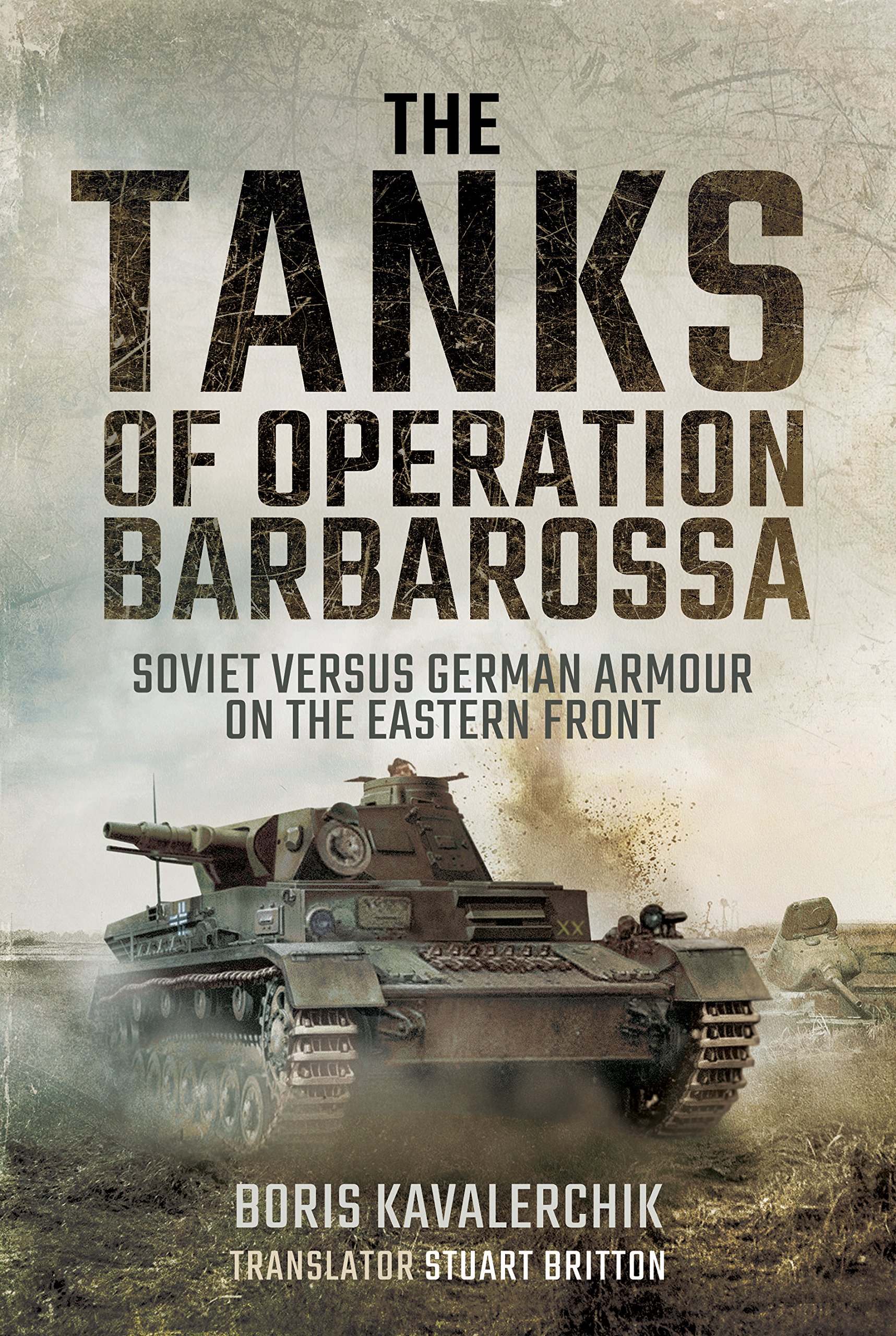
The Tanks of Operation Barbarossa
Boris
Kavalerchik, tank expert and author of the Journal of Slavic Military Studies
article ‘Once
Again About the T-34’ has published a book on ‘The
Tanks of Operation Barbarossa’.
Summary:
When the Germans invaded the Soviet Union in 1941 the Red Army had four times as many tanks as the Wehrmacht and their tanks were seemingly superior, yet the Wehrmacht won the border battles with extraordinary ease the Red Armys tank force was pushed aside and for the most part annihilated. How was this victory achieved, and were the Soviet tanks really as well designed as is often believed? These are the basic questions Boris Kavalerchik answers in this absorbing study of the tanks and the tank tactics of the two armies that confronted each other at the start of the war on the Eastern Front. Drawing on technical and operational documents from Russian archives, many of which were classified until recently and are unknown to Western readers, he compares the strengths and weakness of the tanks and the different ways in which they were used by the opposing armies. His work will be essential reading for military historians who are interested in the development of armoured warfare and in this aspect of the struggle on the Eastern Front.
Q&A with Boris Kavalerchik
The author was kind enough to answer some of my questions.
1) How did
you become interested in WWII history and why did you decide to write a book on
Soviet vs. German tanks during the 1941 campaign?
I've been
reading and collecting books and magazines about all kinds of military hardware
since I was 12 years old. In college, I had to go through military training and
become a tank platoon's commander in reserve, so my knowledge of tanks became
much deeper and more practical than before. After a while I started to realize
that military hardware is nothing without the people who use it, and I began to
pay much more attention to military history.
The Great Patriotic War has always
had special importance for people of the USSR, where I used to live. Many of my
relatives, including my father, fought in that war, and some of them were KIA.
Naturally, I have heard and read a lot about these historic events and become
quite interested in them. Eventually, I co-authored a book about the Soviet
Union and Germany's preparations for WWII, as well as that war's beginning. Tank
warfare played a very important part in determining the outcome of these
battles, so I decided to dedicate a separate study to this subject. That is how
my book came to life.
2) What
new information have you uncovered that differentiates your book from other
similar studies?
In the
USSR, only officially approved historians had access to the state archives.
Moreover, their work had to go through government censorship and could only
support the official point of view on history, which very often was far from
reality. After the collapse of the Soviet Union all archives gradually became
open to regular people who were interested in events from the past.
More and more original archival materials began to be published and even became
available online. As a result, I managed to find a lot of information which was
classified until recently and had been generally unknown, especially to western
readers.
This information allowed me to reach quite different conclusions in
comparison to widely held beliefs about Red Army's tanks during WWII based on
old Soviet propaganda. As a mechanical engineer, I also analyzed and compared
Soviet and German tanks from a purely technical standpoint,
but from rarely used angles which as a rule got neglected. The results struck
me as very unusual and I hope they will be of interest to my book's readers.
3) Do you
think that WWII era armored vehicles truly played a decisive role in combat
operations or has their contribution been exaggerated due to the ‘coolness’
factor?
I think
that a very important role in WWII was played not by armored vehicles
themselves but by armored forces which included not only tanks but motorized
infantry, artillery, combat engineers, anti-tank and anti-aircraft units, and
so on. Moreover, as a rule, armored forces fought successfully only in
combination and cooperation with other services and
branches of the armed forces. Tanks do have the ‘coolness’ factor, so
many people mistakenly take
them for wonder-weapons, capable of independently deciding the outcome of any
battle. In reality, this is not the case. Nevertheless, tanks were a
very significant part of the armed forces of all participants of
WWII.
4) In your
opinion what are the worst mistakes that popular history books make regarding
German and Soviet armored vehicles and the Eastern Front in general?
In my opinion, some authors of popular history books mistakenly judge people of previous generations and their armored vehicles from today's point of view using modern criteria. Every tank, without exception, has both positive and negative aspects. In order to determine them it is necessary to know the purpose and objectives of these tanks, which were not the same in all countries or in all periods of time. So, before criticizing any tank from the past, one should determine why it was designed and built the way it was. After understanding all factors which influenced tank design in a particular time and country, we can judge these combat vehicles much more objectively.
Sunday, December 17, 2017
Criticism by Nigel Askey of the ‘Myth of German superiority on the WW2 Eastern Front’
My opinion on
this matter is given in the following comparisons:
Also note the
following statements by Christopher Lawrence in ‘War
by Numbers: Understanding Conventional Combat‘, p48:
‘We conclude from the Kursk comparison that
the Germans had a clear advantage in combat capability that showed itself in
both offensive and defensive casualty effectiveness and mission accomplishment.
The difference appears to be a factor of 3. This difference appears in the
middle of 1943, after the Soviet Army had two years of wartime experience, was
using experienced units, and had time to rest, train, and rebuild before the
German offensive. Yet there was still a very clear performance difference between
these armies’.
and in page
50:
‘One cannot
help but note that the relative combat performance of the Israelis and the
Arabs in 1956-73 was similar in disparity to that between the Germans and the
Soviets in 1943’.
Understandably the truth hurts…
Additional information: Comments on “Deutsche Militärische Verluste” by Rüdiger Overmans
Wednesday, February 3, 2016
German signals intelligence files in the Russian national archives
At the end of
WWII parts of the German state archives were captured by the Soviet forces and
taken to the Soviet Union. There they were placed in various Soviet state
archives and kept out of reach of researchers. With the fall of the Soviet
Union these archives were opened to researchers but not many people have taken
advantage of that. Thankfully some of these German documents have recently
become available online. The website of The
Russian-German project to digitize German documents in the archives of the
Russian Federation has uploaded a large number of German documents from WWI
and WWII.
The site
says:
‘As a result of the anti-Hitler coalition
victory in the Second World War, documents of Nazi Germany turned up in many
countries, including Russia. Largest collections of German documents are kept
in the Federal archives of the Russian Federation (State Archive of the Russian
Federation (GARF), the Russian State Military Archive (RGVA) and the Russian
State Archive of Socio-Political History (RGASPI)), and in the Central Archive
of the Russian Ministry of Defense (TsAMO). The project to digitize German
documents was initiated by the administration of the Russian President in 2011.
It is executed by the Russian Historical Society, the Ministry of Defense and
the Federal archival agency with support from the German Historical Institute
in Moscow. Coordination committee, overseeing the digitization project, is
headed by S.E. Naryshkin, the Chairman of the State Duma of the Federal
Assembly of the Russian Federation.’
Regarding
German sigint activities during WWII, the search terms ‘Nachrichten Aufklärung’ and ‘horchtruppen’ bring up many
interesting documents. For example:
Baudot
traffic


Reports of
Kommandeur der Horchtruppen Ost


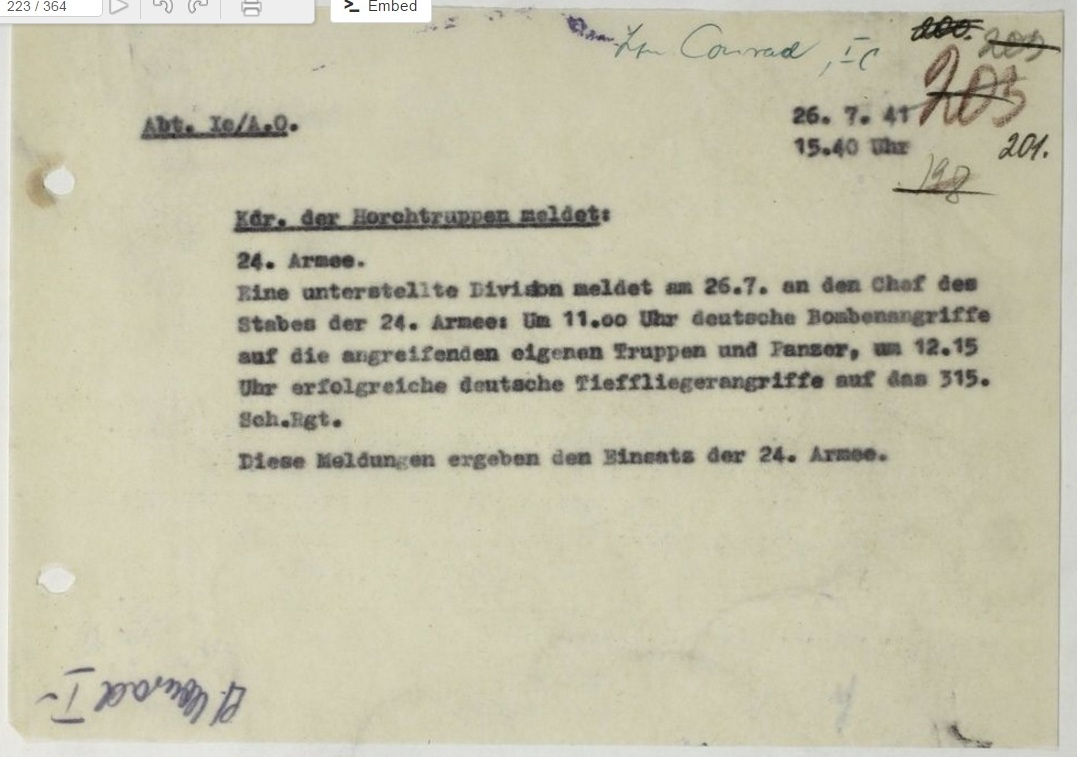


Reports of
Nachrichten Aufklärung Auswertestelle 2


Tuesday, November 10, 2015
Report on the solution and processing of the Soviet Army’s 5-figure code
The use of
signals intelligence and codebreaking by the Germans and Soviets in the Eastern
front is a subject that has received very little attention by historians so
far. The main reason was the lack of adequate sources. The archives of the
Soviet codebreaking organizations remain closed to researchers but in the last
decade many important documents on German signals intelligence operations have
been released to the public archives.
From these
documents it is clear that the Germans invested significant resources in their
signal intelligence agencies and relied on their output during the fighting in
the East. Against an opponent that outnumbered them in men and war materiel
(tanks, planes, artillery) signals intelligence gave them the opportunity to
monitor enemy movements and make efficient use of their limited resources.
The
cryptologic systems used by the Soviet Union at low and mid level were
extensively compromised during the war and in 1941-42 even their high level
5-figure code could be read.
It seems that
in 1942 a detailed report was prepared on the German exploitation of the Soviet
army’s 5-figure code. The report of Area X - (Gebiet X) of April 1942, from the
war diary of Inspectorate 7/VI, says:

Über die lösung, entwicklung und
Bearbeitung des 5Z Materials wird demnächst ein Sonderbericht herausgegeben
werden der die arbeit der Ez.- Gruppe der In 7/VI auf diesem Gebiete eingehend
schildert. Dieser Sonderbericht wird den Zeitraum vom 22.6.41 (Beginn des
Osteinsatzes) bis zum 22 April 1942 (Abgabe der EZ Bearbeitung an die Ez. -
Gruppe des Herrn Prof. N) umfassen.
Translation
by Frode Weierud:
A special report will soon be issued
that will describe in detail the work of the deciphering group of In 7/IV in
solving, developing and processing the Russian 5-figure code. This special
report will cover the period from 22.6.41 (the start of the eastern campaign)
until 22 April 1942 (handing over the processing to the deciphering group of
Professor N.).
Unfortunately
I have not been able to locate this file and it is not mentioned in TICOM
report IF-272 which lists the files of Inspectorate 7/VI recovered in 1947 from
a camp in Austria.
Tuesday, January 6, 2015
Unanswered questions of WWII cryptology – progress report
Back in 2013
I wrote down several
cases of WWII cryptologic history that require more research. Since then
I’ve spent a lot of time and money trying to find new information. Has the
effort paid off? Let’s have a look at each case:
1). US
State Department strip cipher
I wrote: How bad was the compromise of the State
Department’s high level system? That question is hard to answer because
there is limited information available and it doesn’t seem like the Americans
were really interested in learning the full extent of the compromise. Some
documents that would shed more light on this affair are proving very hard to
find…
I’ve been able
to find more information on this case, including the
way the M-138 strip cipher was used by the State Department, decoded US
diplomatic traffic found in
the US and Finnish
national archives, the exploitation
of US traffic by the Japanese in the period 1940-41 and the
efforts of the German cryptanalyst Wolfgang Franz at OKW/Chi.
It is clear
that Germans, Japanese and Finns were able to solve many alphabet strips both
circular and special and thus read State Department messages from embassies in
Europe and Asia. The most important intercepted messages seem to have been
those from Bern, Switzerland and Chungking, China.
Unfortunately
several important reports are still classified by the NSA and we have to wait for
the declassification procedure. At the same time I haven’t been able to track
down the Carlson-Goldsberry
report, detailing the Finnish solution of the State Department strip cipher.
This report was written in late 1944 by two US cryptanalysts after interviewing
Finnish codebreakers in Sweden.
Another
aspect of this case concerns the messages from the OSS
- Office of Strategic Services
and OWI
- Office of War Information
stations in Bern that were also sent via diplomatic channels. It’s not
clear why these messages were sent using State department codes and not through
their own systems. In this area information is lacking, since the OSS organization
doesn’t seem to have officially acknowledged the compromise of their
communications during the war.
2). NKVD 5th Department
codebreakers
During WWII
the Soviet Union invested significant resources in the interception and
exploitation of enemy radio traffic. The internal security service NKVD
and the Army’s general staff had codebreaking departments with the former
recruiting many talented mathematicians. According to author Matthew Aid ‘By the end of World War II, the 5th
Directorate controlled the single largest concentration of mathematicians and
linguists in the Soviet Union.’
So far very limited information is available regarding their war time
efforts versus foreign codes (not only Axis but also US, UK and those of
neutral countries).
3). Referat Vauck success
In the period
1942-44 the German Army’s signal intelligence agency Inspectorate 7/VI had a
separate deparment (Referat 12) assigned with the solution of the encoded
messages of Allied spy groups operating in occupied Europe. Head of the
department was dr Wilhelm Vauck, so his unit was also called Referat Vauck. In 1944 they were transferred to the OKW
radio defense department so their reports can no longer be found in the files
of Inspectorate 7/VI.
I had written about this case: How successful were they during the
war? Unfortunately we do not know. The relevant file in the British national
archives HW 40/76 ‘Enemy exploitation of SIS and SOE codes and cyphers’ says
that postwar files have been retained and my request for the release of the
interrogations of dr Vauck has been rejected by the archives staff
Thankfully I‘ve been able to track down the monthly reports of Referat 12 for the period April ’42-February
’44 and I will be writing an essay on them.
An
interesting discovery, made while I was trying to find information on Referat
Vauck, was that OKW/Chi was also solving Allied agents codes during the war (with
significant success it seems). Not much is known about this aspect of
OKW/Chi operations…
4). Forschungsamt
information
Goering’s Forschungsamt
was one of the main German codebreaking/intelligence agencies of the period 1939-45,
yet a
detailed history of that organization still eludes us. This is another case
where it’s up to the NSA to declassify the relevant documents, written by Forschungsamt
personnel in the 1950’s.
5). German
Enigma investigations
Several
authors claim that the Germans never suspected that their Enigma cipher machine
was solved by the Allies and that they considered it to be unbreakable.
I had
written: The Germans constantly evaluated
the security of their Enigma cipher machine. There were many studies on whether
the daily key or parts of it could be retrieved through cryptanalysis. Those
studies are the TICOM DF-190 to DF-190AN files…..More research is needed to
evaluate the German methods and the way they influenced their security
measures.
Since then
I’ve posted information on case
‘Wicher’ (Polish solution of the Enigma) showing that the Germans knew the
device had been compromised in the prewar period and in 1943 they got information
from the US regarding the solution of their naval version. So far it’s clear that the German Navy’s
codebreakers found
a solution for their 4-rotor machine in late ’44 but we don’t know much about
the similar work of the Army cryptanalysts. More research is needed in this
case.
6). Japanese
Purple and Coral cipher machines
Were the
Germans able to solve the cipher machines used by the Japanese foreign ministry
and by Japanese military attaches?
I wrote: PURPLE was solved by American and Soviet
codebreakers. Did the Germans have any success with it? Until recently the
answer was no.
However it seems there is more to this story.
The Coral machine was used by military
attaches and the Anglo-Americans solved it in 1944. In the same year dr
Steinberg of the German Army’s signal intelligence agency was transferred to
OKW/Chi where he worked on a cipher machine used by the Japanese attaché. Did
he manage to solve it?
TICOM report I-64 ‘Answers by Wm.
Buggisch of OKH/Chi
to Questions sent by TICOM’ says ‘B. thinks Steinberg (of
209 fame) solved some Jap machine traffic which was difficult but not so hard
as Enigma. B. thinks it was traffic of the Jap Military Attache.’
There is
scattered information that points towards the solution of an important Japanese
code or cipher machine in the period 1943/44 but no conclusive evidence. Maybe
more information will become available in the future.
7). Soviet
diplomatic code
I wrote: The Soviet Union used a code enciphered with
one time pads as its main diplomatic system during WWII. This system if used
correctly is unbreakable.
Were the Germans able to read parts of
this traffic? There are some strange statements in Allied and German
reports…
The recently
declassified TICOM report DF-111 ‘Comments on various
cryptologic matters’ by Adolf Paschke (head of the linguistic cryptanalysis
group in the German foreign ministry’s decryption department) says that in the
years 1927-30 parts of the Soviet diplomatic traffic could be read since the
additive pads were sometimes used twice if the message was long enough. Paschke
had also identified the use of the same additive tables more than once in some
links. Regarding wartime traffic he says that they couldn’t solve any since
there were no repetitions but in the report he also added cryptically that
Russian material of the Forschungsamt and the High Command’s deciphering
department OKW/Chi were destroyed in 1943 during a bombing attack on Berlin.
Although the
Germans might have not solved any Soviet diplomatic traffic they did succeed in
solving Comintern
communications.
8). M-209
decoding device
I wrote: I’m surprised that no one has figured
out how this machine worked!
I have to say
I’m still surprised that this device has not received any attention from
historians and/or the media!
Tuesday, July 22, 2014
Compromise of Soviet codes in WWII
Signals intelligence and codebreaking played an important
role in WWII. British and American codebreakers solved many important Axis
crypto systems, such as the German Enigma machine and the Japanese Navy’s code
JN25.
Historians have not only acknowledged these Allied successes
but they’ve probably exaggerated their importance in the actual campaigns of
the war.
Unfortunately the work of the Axis codebreakers hasn’t
received similar attention. As I’ve mentioned in my piece Acknowledging
failures of crypto security all the participants suffered setbacks
from weak/compromised codes and they all had some successes with enemy systems.
Britain, the Soviet Union and the United States did not have
impenetrable codes. In the course of WWII all three suffered setbacks from
their compromised communications.
After having dealt with the United
States and Britain it’s
time to have a look at the Soviet Union and their worst failures.
Move along comrade, nothing to see here
Compromises of communications security are usually difficult
to acknowledge by the countries that suffer them. For example since the 1970’s
countless books have been written about the successes of Bletchley Park, yet
detailed information on the German solution of Allied codes only started to
become available in the 2000’s when TICOM reports and other relevant documents
were released to the public archives by the US and UK authorities.
In Russia the compromise of their codes during WWII has not
yet been officially acknowledged and the archives of the codebreaking
organizations have remained closed to researchers. This is a continuation of
the Soviet policy of secrecy.
The Soviet Union was a secretive society and information was
tightly controlled by the ruling elite. This means that history books avoided
topics that embarrassed the regime and instead presented the officially
sanctioned version of history. Soviet era histories of WWII avoided references
to codes and ciphers and instead talked about ‘radio-electronic combat’ which
dealt with direction finding, traffic analysis and jamming (1).
After the fall of the Soviet Union several important
government archives were opened to researchers and this information has been incorporated
in new books and studies of WWII. However similar advances haven’t taken place
in the fields of signals intelligence and cryptologic history. Unlike the US
and UK that have admitted at least some of their communications security
failures the official line in Russia is that high level Soviet codes were
unbreakable and only unimportant tactical codes could be read by the Germans.
Even new books and studies on cryptology repeat these statements (2).
However various sources such as the TICOM reports, the
war diary of the German Army’s signal intelligence agency Inspectorate 7/VI and the monthly reports of the cryptanalytic
centre in the East Horchleitstelle Ost
clearly show that the Germans could solve even high level Soviet military and
NKVD codes. Sunday, April 20, 2014
Soviet pre-arranged form reports
The war
between Nazi Germany and the Soviet Union was the largest land campaign of
WWII, with millions of troops fighting in the vast areas of Eastern Europe. In
this conflict both sides used every weapon available to them, from various
models of tanks and self propelled guns to fighter and bomber aircraft. However
an aspect of the war that has not received a lot of attention from historians
is the use of signals intelligence and codebreaking by the Germans and the Soviets.


By analyzing
this information the Germans were not only able to monitor the strength and
equipment situation of enemy units but also make deductions about overall
Soviet strategy.
Codebreaking
and signals intelligence played a major role in the German war effort. The
German Army had 3 signal intelligence regiments (KONA
units) assigned to the three Army groups in the East (Army Group North,
South and Centre). In addition from 1942 another one was added to monitor
Partisan traffic. The Luftwaffe had similar units assigned to the 3 Air Fleets
(Luftflotten) providing aerial support to the Army Groups. Both the Army and
the Luftwaffe also established central cryptanalytic departments
(Horchleitstelle Ost and LN Regt 353) for the Eastern front in East
Prussia. During the war this effort paid off as the German codebreakers could
solve Soviet
low, mid and high level cryptosystems. They also intercepted the internal
radio teletype network carrying economic and military traffic and used
traffic analysis and direction finding in order to identify the Soviet order of
battle.
An important
source of information on the Soviet military was their pre-arranged form
reports sent at regular intervals by all units to their higher headquarters.
These messages used a pre-arranged format to communicate strength,
serviceability and loss statistics. By reading these messages the Germans were
able to monitor the strength, losses and reinforcements of Soviet formations.
Luftwaffe
Chi Stelle effort
Several TICOM
sources give information on the exploitation of these pre-arranged reports by
the codebreakers of the Luftwaffe. According to IF-187 Seabourne Report,
Vol. XII. ‘Technical Operations in the East, Luftwaffe SIS’ (available from
site Ticom
Archive) pages 5-8 the reports had information on the condition of Soviet
airfields, stocks of planes, ammunition, rations and fuel.
TICOM report
I-107 ‘Preliminary
Interrogation Report on Obltn. Chlubek and Lt. Rasch, both of III/LN. RGT. 353’,
p4 says that the pre-arranged reports were extremely valuable to the Luftwaffe.
Army’ s
General der Nachrichten Aufklaerung effort
According to
FMS P-038 'German Radio intelligence', p115-7 pre-arranged reports sent by
Soviet Army units contained information on personnel strength, losses, number
of vehicles, guns, ammunition gasoline supplies and similar statistical data. Thursday, April 3, 2014
Some thoughts on Soviet tank reliability in WWII
The Eastern
front was the largest land campaign of WWII and millions of soldiers fought and
died there in the period 1941-45. Although infantry dominated the fighting both
sides used a large number of tanks and armored vehicles and these played a big
role in breakthrough operations. Most historians focus on the ‘paper’
characteristics of tanks and the production statistics however a very important
aspect of complex weapon systems is their reliability and kill/loss ratio. In
the East the Germans were always outnumbered but the exchange
ratios were in their favor. I’ve often wondered of how much that has to do with
poor reliability of Soviet equipment.
Here is
something I read recently from ‘Moscow
to Stalingrad: Decision in the East’ by Earl F. Ziemke, in page 363:
Active as it was, the Soviet armor was
apparently not giving fully satisfactory performance at this stage, and in
early August, it became the subject of the following Stalin order:
‘Our armored forces and their units
frequently suffer greater losses through mechanical breakdowns than they do in
battle. For example, at Stalingrad Front in six days twelve of our tank
brigades lost 326 out of their 400 tanks. Of those about 260 owed to mechanical
problems. Many of the tanks were abandoned on the battlefield. Similar
instances can be observed on other fronts. Since such a high incidence of
mechanical defects is implausible, the Supreme Headquarters sees in it covert
sabotage and wrecking by certain elements in the tank crews who try to exploit
small mechanical troubles to avoid battle.’
Henceforth, every tank leaving the
battlefield for alleged mechanical reasons was to be gone over by technicians,
and if sabotage was suspected, the crews were to be put into tank punishment
companies or "degraded to the infantry" and put into infantry
punishment companies.'"
Were the
problems really caused by sabotage and wreckers? Apparently not, since captured
T-34
tanks used by the Germans in summer 1944 had the following problems:
‘Regardless of our limited experience, it can be stated
that the Russian tanks are not suitable for long road marches and high speeds.
It has turned out that the highest speed that can be achieved is 10 to 12
km/hr. It is also necessary on marches to halt every half hour for at least 15
to 20 minutes to let the machine cool down. Difficulties and breakdowns of the
steering clutches have occurred with all the new Beute-Panzer. In difficult
terrain, on the march, and during the attack, in which the Panzer must be
frequently steered and turned, within a short time the steering clutches
overheat and are coated with oil. The result is that the clutches don't grip
and the Panzer is no longer maneuverable. After they have cooled, the clutches
must be rinsed with a lot of fuel.’
Also T-34
tanks captured by the Americans in Korea (built in 1945) continued to suffer
from the same issues. According to Zaloga’s ‘T-34-85 Medium Tank’, p21-22
An analysis of a T-34-85 captured in
Korea by the American tank producer Chrysler, conducted in 1951, provides a
good assessment of the T-34- 85……………………. The study, found the following
negative features about the tank:…………………………………. Wholly inadequate engine intake
air cleaners could be expected to allow early engine failure due to dust intake
and the resulting abrasive wear. Several hundred miles in very dusty operation
would probably be accompanied by severe engine power loss.' The report was also
critical of the lack of a turret basket, poor fire fighting equipment, poor
electrical weatherproofing, lack of an auxiliary generator to keep the
batteries charged, and lack of a means to heat engine oil for cold weather
starts. The report noted that although Soviet manufacturing techniques were
adequate for the job, there were many instances where poor or unskilled
workmanship undermined the design, and where overworked machines led to course
feeds, severe chatter or tearing of machined surfaces, a consequence no doubt
of the extreme pressures placed on plants to ensure maximum output. For
example, in the tank inspected (manufactured in 1945) the soldering job on the
radiator was so poor that it effectively lost half of its capacity.
It’s also
worth noting that even in 1941 German reports on captured Soviet T-26 and BT
tanks pointed out serious productions issues. For the T-26 tank: ‘The Pz.Kpfw.Zug created by the
division is no longer operational. One Panzer is completely burnt out due to an
engine fire. Both of the other Panzers have engine and transmission problems.
Repetitive repairs were unsuccessful. The Panzers always broke down after being
driven several hundred meters on good roads. As reported by technical
personnel, both of the engines in the Panzers are unusable because they were
incorrectly run in.’
And for the BT tank: ‘B. T. (Christi): The main cause of
failure is a transmission that is too weak in combination with a strong engine
that should provide the tank with high speed, but is over-stressed when driven
off road where the lower gears must be used for longer periods. In addition, as
in the T 26, problems continuously arise that are due to entire design and poor
materials, such as failure of the electrical system, stoppages in fuel
delivery, breaks in the oil circulation lines, etc.’
Finally there
are the Aberdeen
tests on a T-34 tank:
'On the
T-34 the transmission is also very poor. When it was being operated, the cogs completely
fell to pieces (on all the cogwheels). A chemical analysis of the cogs on the
cogwheels showed that their thermal treatment is very poor and does not in any
way meet American standards for such mechanisms.’
‘The
deficiency of our diesels is the criminally poor air cleaners on the T-34. The
Americans consider that only a saboteur could have constructed such a device’
The
reliability issues of Soviet tanks during WWII point to serious problems with
Soviet industry. The only other explanation is that a huge Nazi/White Guard
wrecker movement existed in Soviet factories…
I think that
even comrade Stalin would find this idea implausible!
Saturday, March 1, 2014
Recommended reading on the Eastern Front
Every year
countless books dealing with WWII are published worldwide. Many cover the
fighting in the East between Nazi Germany and the Soviet Union. This conflict was
the largest land campaign of the war and claimed the lives of millions of
people. There is no shortage of great battles for authors to write about such
as the battles of Moscow,
Stalingrad, Kursk etc
However with
so many books available there is the problem of quantity vs quality. How many
books have accurate information from both sides? How many present new
information?
Unfortunately
many books that I’ve read have serious mistakes because they rely mostly on
other books for their information and not on the relevant archives. This is
understandable since researching the archives is very costly both in terms of
time and money.
What i look
for in a book is clearheaded analysis and lots of statistical data from both
sides. Based on this what are the books that I can recommend?
First let’s
have a look at the ones that I found lacking.
Two of the
most popular Eastern Front histories are ‘When
Titans Clashed: How the Red Army Stopped Hitler’ by David Glantz and Jonathan House and ‘Russia's
War: A History of the Soviet Effort: 1941-1945’ by Richard Overy. Having read them I can say that they have serious mistakes
since they rely on Soviet sources for information on German strength and loss
statistics. This leads to exaggerations that could have been avoided had the
authors used the reports available from the German archives.
In addition there are other mistakes scattered throughout both books. For
example Overy writes in chapter ‘The Citadel: Kursk 1943’ that the T-34 got a
3-man turret in 1943. He’s off by a year. This might seem like a small mistake
but it undermines his argument that the Soviet forces won the battle not through
numerical superiority but because they upgraded their equipment and tactics.
‘When Titans clashed’ is guilty of perpetuating several WWII myths. For
example the chapter ‘An army in disarray, 1937-1939’ exaggerates the effects of
the purges on the Red Army. Despite its
flaws ‘Russia’s war’ points out in chapter ‘The darkness descends’ that during
the period 1936-38 41.218 officers were dismissed, not executed (or even
all arrested). By May 1940 11.596 officers had been reinstated. The book says ‘Of the 179.000 officers employed in 1938
only 3.7 per cent were still formally discharged by 1940’. It is true that
the higher ranks suffered disproportionately but many of these officers (such
as Marshall Tukhachevsky) were lackeys of the regime and had not gained
their position by merit. In chapter ‘The Red Army’ the T-26 tank is called
‘aging’ and ‘obsolete’ even though its operational characteristics were similar
or superior to the German tank types Pz I, Pz II, Pz 35, Pz 38 and Pz III. Why
was this tank ‘obsolete’? Its main problem was the 2-man turret and by that
standard the mythic T-34 was also ‘obsolete’ since it only got a 3-man turret
in 1944.
Having said that let’s take a look at some very interesting books:Monday, December 16, 2013
Soviet signals intelligence and the German Enigma cipher machine
From the mid
1930’s the German Armed forces started using the plugboard Enigma as
their main crypto system. The Enigma has received a lot of attention from
historians since the solution of this traffic by the codebreakers of Bletchley
Park played a role in WWII operations.


This information
seems to be confirmed by the war diary of the German Army’s Inspectorate 7/VI.
The March 1943 report of Referat 13 (security of
German cipher machines) says that based on the published radio dispatches from Stalingrad Inspectorate 7/VI was asked to give an opinion from the point of view of decipherment.

Sources: ‘Russian signals intelligence 1941-45’, Intelligence and National Security article: ‘The Soviets and naval enigma: Some comments’, The History of Information Security: A Comprehensive Handbook chapter 17-‘Eavesdroppers of the Kremlin: KGB sigint during the Cold war’, Cryptologia article: ‘Summary Report of the State of the Soviet Military Sigint in November 1942 Noticing ‘ENIGMA’, Cryptologia article: ‘Soviet comint in the Cold war’, ‘Journal of Contemporary History’ article: ‘Spies, Ciphers and 'Zitadelle': Intelligence and the Battle of Kursk, 1943’, Inspectorate 7/VI Kriegstagebuch, ‘О ВКЛАДЕ СОВЕТСКИХ КРИПТОГРАФОВ В ПОБЕДУ ПОД МОСКВОЙ’
Were the
Soviets also able to solve the Enigma machine cryptanalytically? Initially there
were two
main Soviet cryptologic departments during WWII, one under the NKVD’s 5th Special Department and the other under the GRU’s
8th Department. In 1942 the Army’s cryptologic department was absorbed by
the NKVD department.
According to
historian Matt Aid ‘By the end
of World War II, the 5th Directorate controlled the single largest
concentration of mathematicians and linguists in the Soviet Union.’
With so many talented
mathematicians could the Soviets have figured out how to solve the Enigma?
Could they have built special cryptanalytic equipment like the British bombes?
Let’s have a
look at the available information.
Regarding
the theoretical solution of the Enigma:
David Kahn
who interviewed
KGB General Nicolai Andreev (head of the KGB’s sigint department in the 1970-80's)
in 1996 was told that the Soviets knew how to solve the Enigma and although
they didn’t have bombes ‘it might have been possible to organize
people to replicate the mechanisms work’.
Regarding
special cryptanalytic equipment:
The Cryptologia article ‘Summary Report of the State of the Soviet
Military Sigint in November 1942 Noticing ‘ENIGMA’ has a report from the GRU that says:
‘The research group of our office has revealed the possibility of solving
German messages enciphered on the ‘Enigma’ machine, and started to construct
equipment, speeding up the solution’
Captured material:
There can be no doubt that during the war both Enigma machines and
valid keylists fell into Soviet hands.
1). In December 1941 Enigma machines and documentation were lost by the
German 2nd Army.
2). After the surrender of the encircled German forces in Stalingrad in
early 1943 Enigma machines and documents plus signals personnel fell into
Soviet hands.
3). According to the memoirs of Admiral Golovko documents were retrieved
from the sunken U-boat
639 in August 1943: ‘Submarine S-101, which sank U 639 and
recovered lists of call-signs and codes which made it possible to keep track of
enemy submarines throughout the Northern theatre’
4). During the summer ’44 battles several German units were encircled and
destroyed. It is safe to assume that a lot of crypto material was lost.
Help from abroad:
During WWII their spy John Cairncross was
able to infiltrate Bletchley Park and he gave the Soviets copies of the
documents that he had access to. Some dealt with the Enigma.
So it is
certain that the Soviets were able to solve Enigma messages thanks to
compromised material and the possibility that during the war they managed to
retrieve the daily Enigma settings cryptanalytically cannot be discounted. The
only way to know for sure is for the Russian government to give researchers
access to the wartime files of the NKVD 5th Department.
Another way
is to look for information from other available sources. One such source is the
report ‘Russian signal intelligence 1941-45’ by Lt Col Fritz Neeb, head of
evaluation for NAAS 2 (Signal Intelligence Evaluation Center) of KONA 2
(Signals intelligence Regiment 2) assigned to Army Group Centre in the Eastern
Front.
According to
Neeb the Soviet signals intelligence organization was as good as or better than
the Germans in traffic analysis and direction finding. However it doesn’t seem
like they were able to solve German Enigma traffic, at least up to late 1942.
In page 17 of
his report he says that during the Stalingrad battle a Soviet 5-figure message
was decoded and it contained a signals intelligence report. The report showed
that the German units in the area were correctly identified but there was a
mistake in their numerical designation. This would imply that the information
came from sources other than cryptanalysis since in German messages numbers had
to be spelled out.


According to
the recent article ‘О ВКЛАДЕ
СОВЕТСКИХ КРИПТОГРАФОВ В ПОБЕДУ ПОД МОСКВОЙ’, in late 1942 the Soviet
codebreakers analyzed the Enigma cipher machine and developed ways of solving
it. However their efforts failed in
January 1943 due to new German
security measures.

Schlüsselüberwachung
Auf grund der veröffentlichten
Funksprüche asus Stalingrad wurde In 7/VI um ein allgemeines Gutachten gebeten,
das die Stellungnahme vom Standpunkt der Entzifferung enthält.
Thus it seems
that the Soviet effort to decrypt Enigma messages was identified early and
countered by the Germans.
Sources: ‘Russian signals intelligence 1941-45’, Intelligence and National Security article: ‘The Soviets and naval enigma: Some comments’, The History of Information Security: A Comprehensive Handbook chapter 17-‘Eavesdroppers of the Kremlin: KGB sigint during the Cold war’, Cryptologia article: ‘Summary Report of the State of the Soviet Military Sigint in November 1942 Noticing ‘ENIGMA’, Cryptologia article: ‘Soviet comint in the Cold war’, ‘Journal of Contemporary History’ article: ‘Spies, Ciphers and 'Zitadelle': Intelligence and the Battle of Kursk, 1943’, Inspectorate 7/VI Kriegstagebuch, ‘О ВКЛАДЕ СОВЕТСКИХ КРИПТОГРАФОВ В ПОБЕДУ ПОД МОСКВОЙ’
Subscribe to:
Posts (Atom)