Showing posts with label partisan codes. Show all posts

Saturday, May 27, 2017

The compromise of Greek partisan radio communications in WWII

A history lesson

At the start of WWII the Kingdom of Greece, ruled by Ioannis Metaxas  (head of the 4th of August Regime) followed a neutral foreign policy and tried to avoid taking part in the conflict. However constant Italian harassment and provocations (such as the sinking of the cruiser Elli) and the transfer of Italian army units to Albania made it clear that war could not be avoided for long.

In October 1940 Italian forces invaded Greece, in the area of Epirus, and the Greek-Italian war started. The Greek forces were able to contain the assault and the Greek counterattack forced the Italians back into Albanian territory. After the defeat of a major Italian offensive in spring 1941 the front stabilized inside Albania.

At the time Britain was overextended with obligations in Europe, Middle East and Asia. However the British armed forces made a small contribution with an RAF expeditionary corps. When more British forces started to arrive in March 1941, their involvement gave Germany an excuse to become involved in the conflict.

German forces invaded Greece in April 1941 and made rapid progress due to the fact that almost the entire Greek Army was fighting in the Epirus area. The remaining units and the small British forces transferred to Greece in March-April 1941 were unable to stop them. Then in May 1941 the Germans were also able to defeat the Greek and British forces that had retreated to the strategic island of Crete.

In the period 1941-44 Greece was split into three occupation zones, controlled by Italy, Germany and Bulgaria.  This measure fractured the Greek economy and together with hyperinflation and loss of value of the paper currency led to the collapse of the economy.
Greece was a poor agricultural country prior to WWII. The war of 1940-41, the splitting of the country into three occupation zones and the confiscation of goods by the occupying powers led to the impoverishment of an already poor population.

Greek resistance groups

Under these circumstances several resistance groups were formed by Greek patriots in order to oppose the Axis powers.

Small groups operated in urban centers but the bigger ones could only survive in the countryside where the presence of Axis troops was limited.

The main ones were the military wing of the Greek Communist Party - ELAS (Greek People's Liberation Army) and the liberal EDES (National Republican Greek League).

The resistance forces organized by the Communist Party were ostensibly created in order to oppose the Axis rule and liberate Greece but in reality their main goal was to eliminate their liberal rivals, unify all resistance groups under communist control and gain power in postwar Greece (1).

During the period 1943-44 the Communist forces showed more interest in attacking and destroying other resistance groups than in attacking the occupiers. One of their most infamous acts was the destruction of the EKKA (National and Social Liberation) resistance group and the execution of its commander Dimitrios Psarros.

The ΕΑΜ ELAS movement grew in power during the occupation for several reasons. Compared to the other resistance groups it had an advantage in that it was tightly controlled by the Communist Party, an organization that knew how to operate in adverse conditions. The main achievement of the communists was that they managed to get British backing for their operations. British liaison officers were transported to Greece and British money and arms supported the ΕΑΜ ELAS movement.

In addition to British support, with the collapse of Italy in September 1943, several Italian military units in the Balkans surrendered to the partisans and the capture of their heavy weapons (mortars, artillery, machine guns) gave ΕΑΜ ELAS the ability to conduct regular military operations.

Radio communications and ciphers of the ELAS movement

According to German sources ELAS radio communications began to be intercepted by the units of KONA 4 (Kommandeur der Nachrichtenaufklärung - Signals Intelligence Regiment) in early 1944.

KONA 4 was a German Army signal intelligence unit assigned to cover radio traffic from the Balkans and the Middle East. In the period 1943-44 the unit was able to decode a large volume of Yugoslav partisan traffic.

The quarterly reports of the unit for 1944 (2) show that Greek communist radio traffic was worked on by NAZ G (Nachrichten Nahaufklärungszug - Close Range Signal Intelligence Platoon).


The report Ez Bericht 1944/II says that in April 1944 radio traffic of the Greek communist groups from the areas Volos, Lamia and Olympus was intercepted. The messages were sent in 4-figure and 5-letter groups. The first procedure was a letter to figure Caesar cipher and it was discontinued by the end of April. The second procedure was double transposition with the same key used for both cages. Both were solved and 240 messages read.


Elas-Funkverkehr

Mitte April wurde erstmalig ein griechischer kommunistischer Bandenfunkverkehr mit Funkstellen im Raum Volos - Lamia und im Olymp-Gebiet festgestellt. Seither sind hauptsächlich zwei Arten von Chisprüchen der Elas (Griechisches Volksbefreiungsheer)- Verkehre angefallen: 4Z- und 5B-Sprüche.

a) 4Z-Sprüche.
Statistische Untersuchungen des Spruchmaterials ergaben eindeutige Hinweise auf ein mehrfach belegtes 2Z-Cäsar-Verfahren, das in seinen verschiedenen Schlüsselformen durch 4Z-Kenngruppen bezeichnet wird. Es wurden schliesslich fünf derartige 2Z-Buchstaben-Silben-Cäsaren gelöst. Bereits Ende April wurde dieses Verfahren ausser Kraft gesetzt.

b) 5B-Sprüche. 
Die in grösserem Umfange zwischen dem Obkdo. der Elas und der Gruppe der Divisionen Makedoniens mit ihren unterstellten Einheiten abgesetzten 5B-Sprüche wurden als Klartext-Verwürfelungen erkannt. Untersuchungen auf einfache Verwürfelungen waren erfolglos. Erst als zwei nahezu textgleiche Sprüche mit gleicher 4Z-Kenngruppe auftraten, von denen der eine die mit einer Spalten-vertauschung versehene Wiederholung des anderen war, konnte die Losung erstellt und der Spruch als Doppelwürfelverschlüsselung gelöst werden. Die folgende Entschlüsselung aller mit dieser Losung verzifferten Sprüche ergab, dass der Verschlüssler beim Obkdo der Elas besonders für volle Würfel eine Vorliebe hat. Diese Annahme bestätigte sich, als festgestellt wurde, dass darüber hinaus sogar qruadratische Würfel vorlagen, für die eine einfache Lösungsmöglichkeit besteht. In arderen Fällen lagen der Verschlüsselung halbquadratische Würfel zugrunde. Solche können gleichfalls gelöst werden, da in zwei Halbzeilen des waagerecht eingetragenen Chitextes oft eine bekannte Unterschrift gefunden werden kann. Unter Ausnutzung dieser Verschlüsselungsschwächen des Gegners wurden bisher 20 Doppelwürfelosungen erstellt.
In der Berichtszeit wurden insgesamt ca 240 Sprüche mitgelesen die wertvolle Aufschlüsse über den organisatorischen Aufbau, die militärische Gliederung und die militärischen Aktionen der kommunistischqp Banden im griechischen Raume gaben.

ELAS radio-traffic

Mid-April radio communications of a Greek Communist gang , with radio stations in the area of Volos - Lamia and Olympus, was detected for the first time. Since then, mainly two kinds of cipher messages in the ELAS traffic (Greek people's Liberation Army) have turned: 4-figure and 5-letter messages.

a) 4-figure messages.
Statistical investigations of the intercepted material gave clear indications of a multiply occupied 2-figure Caesar system, which in its various cipher forms is identified by 4-figure indicator. Finally five such 2-figure letter-syllable Caesars were solved. Already at the end of April this procedure was cancelled.

b) 5-letter messages.
The 5-letter messages, which in larger extent were sent between the ELAS headquarter and the group of divisions in Macedonia with its subordinate units, were recognized as plaintext transpositions. Studies based on simple transpositions were unsuccessful. It was not until two nearly textually equal messages with the same 4-figure indicator group occurred, of which one could be seen as a column swapped repetition of the other, that an answer was found and the message solved as a double transposition. The following decryption of all the enciphered messages with this solution revealed that the cipher clerk at ELAS headquarter had a special preference for complete transposition rectangles. This assumption was confirmed when it was found that it even square transposition templates was used, for which there exist a simple solution. In other cases, the enciphering was based on using half-square transposition templates. Those can equally be solved because in two half-lines of the vertically entered ciphertext one often will find a well-known signature. So far 20 double transposition solutions have been created using these encryption weaknesses of the enemy.
During the period under review a total of about 240 messages were read which gave valuable insights into the organizational structure, the military plans and the military action of the Communist rings in the Greek area.

The report Ez Bericht 1944/III says that double transposition continued to be used in ELAS radio communications. Due to poor cipher practices this system could be solved. In the reporting period about 120 keys were solved and 2.200 messages read.


Elas bewegung

Sämtliche Funkverkehre der Elas-Bewegung im griechischen Raume verwenden nach wie vor die Dopelwürfelverschlüsselung. Aus der bereits im letzten Bericht erwähnten Vorliebe der gegnerischen Schlüssler für volle Würfel hat sich ein gangbarer Weg zur Lösung dieser Doppelwürfel finden lassen. Unter Verwendung bereite bekannter Unterschriften wurden die Würfellosungen gefunden an quadratischen, doppelquadratischen, halb- und viertel-quadratischen Würfeln, ferner an längen- und lösungsgleichen Würfeln und Würfeln mit Spaltenvertauschung, Dass in einer Anzahl von bereits entzifferten Sprüchen auch Hinweise auf neue Losungen gegeben wurden, erleichterte die Entzifferungsarbeit beträchtlich.

Mit ca. 120 Losungen konnten in der Berichtszeit nahezu 2.200 Sprüche mitgelesen werden,

ELAS movement:

All radio traffic of the ELAs movement in the Greek area still uses the double transposition system. From the preference of the enemy cipher clerks for complete transposition squares, as mentioned in the last report, a practical method of solving this double transposition has been found. By using well-known signatures solutions were found for square, double square, half - and quarter square transposition templates, as well as solutions to same length and solution-equal transposition templates and templates with column swapping.
The decipherment work was eased considerably by the fact that a number of already decrypted messages also gave hints about new solutions. With about 120 solutions nearly 2,200 messages could be read during the reporting period.

The last report Ez Bericht 1944/IV says that approximately 50% of the messages were read:


Elas Bewegung

Der griechische Bandenfunk wurde ausschliesslich von NNA Zg G bearbeitet, der sich in der Berichtszeit 2 Monate auf dem Rückzug befand. Im letzten Vierteljahr 1944 wurde als einziges Verfahren der Doppelwürfel verwendet . Ungefähr 50% der angefallenen Sprüche wurden mitgelesen. Für ca. 30 Kenngruppen wurden die Losungen  erstellt.

ELAS movement

The Greek agent radio traffic was processed exclusively by NNA Zg G who, during the reporting period, had already been on the retreat for 2 months. In the last quarter of 1944 the only method used was double transposition. Approximately 50% of the attacked messages were read. Solutions were found for about 30 characteristic groups (indicators).

Dr. Otto Karl Winkler and TICOM report I-170

Additional information on the exploitation of ELAS communications is available from the TICOM report I-170 ‘Report on French and Greek Systems by Oberwachtmeister Dr. Otto Karl Winkler of OKH/FNAST 4’ (dated January 1946).

The report was written by Dr. Otto Karl Winkler, a member of KONA 4. Dr Winkler was in charge of decoding and translating the Greek messages and in pages 4-6 he stated about his work:


The unit moved to BELGRADE in Autumn 1943, thence, in August 1944 to PERNITZ near WIENER NEUSTADT, However, I received a new task in Spring 1944 with the appearance of Greek messages sent by ELAS. In the course of our two year stay in Athens I had been able to learn modern Greek almost perfectly, on the basis of a knowledge of classical Greek and spurred on by love for and interest in Greece. In addition my duties had provided me with a certain experience of cryptography and a good translation technique. Thus I was put in charge of Greek cryptography and was assisted in the actual cryptographic work by Uffz. Diether STROBL from BERLIN, an English interpreter and technical student. I had held the rank of Wachtmeister since Christmas 1943.

Regarding the cipher systems used he also mentions the 2-figure Caesar system and the double transposition cipher. Solution of the latter depended on the poor practices of the ELAS cipher clerks:


Double transpositions are regarded as a secure type of cipher and are therefore used by many British agents. To the best of my knowledge the unit never succeeded in breaking one and only occasional captured material has rendered it possible to read some traffic retrospectively. For the sake of security it is essential to avoid using complete or even square boxes, typical beginnings or endings of messages and constantly recurring addresses and signatures, to use each key as little as possible and as far as possible to have different keys for each box of the pairs The Greeks overlooked all these rules right up to the end, with the result that messages in the same setting and with the same number of groups (Elementeanzahl) cropped up.

The solution of these messages provided valuable information about the organization, personalities and operations of the ELAS partisan forces:


In any case we succeeded in breaking 50 – 60% of the traffic tackled and as important messages were always retransmitted on several links with different keys, we were able to build up an almost complete picture of the build-up, organization and composition of EAM and ELAS, to compile lists of their leading personalities and officers and to inform the competent German political and military authorities in good time about many planned military and political actions, acts of sabotage, ambushes, dynamitings, etc. I can only remember a few details and cannot reproduce examples systematically as the evaluation of the material wan not my job, which consisted only of deciphering, decoding and translating the available material.

Radio traffic of British liaison officers in Greece

Apart from ELAS communications the Germans were also able to read some of the messages sent by British liaison officers assigned to the Greek partisans. The German Army’s codebreaking agency OKH/Inspectorate 7/VI was able to decode some of these messages in the period 1943-44 (3).

The British authorities kept in contact with partisan groups in the Balkans through liaison officers sent by the intelligence services SIS and SOE. These small teams transmitted traffic by radio to their controlling stations in Cairo, Egypt and Bari, Italy. The cryptosystems used were double transposition and the War Office Cypher, enciphered with one time pads.
Some of the encoded radio traffic of British officers in the Balkans was exploited by the Germans. They were able to read messages both through captured material and by cryptanalysis. 

The reports of KONA 4 show that some cipher material was captured in the field and messages read. For example in 1943:


Field units had to rely on captured material in order to read British agents transmissions but this was not necessarily true of the central department. The reports of Inspectorate 7/VI show that this traffic (special traffic to Cairo with indicator GESH) was first solved in June 1943 by Referats 6 and 12:


Traffic continued to be read till November 1944 but it seems this was mostly from the team assigned to the headquarters of General Mihailović and from the liaison officers in Greece. 

For example:

September ’43:


April ’44:


July ’44:


Conclusion

In the period 1941-44 the Greek population suffered under a triple occupation by Italian, German and Bulgarian forces. The collapse of the Greek State, of the economy and the falling living standards led many Greeks to take up arms against the occupiers.

This situation gave the Greek Communist Party an opportunity to build up a large partisan movement in the countryside and use it to monopolize the anti Axis resistance in Greece. With support from the British and after capturing Italian heavy weapons in 1944 the Communists were one step away from gaining power in the country.

During this period the German authorities were aware of the growing strength of the partisan movements in the Balkans but they did not have the military forces needed to permanently destroy them. Instead their forces garrisoned strategic areas and urban centers.

Both in Yugoslavia and in Greece they were able to monitor the military operations and political maneuvers of the partisan movements through signals intelligence.

In 1944 the German Army’s signal intelligence agency was able to solve a large part of the ELAS radio traffic. Their success was possible mainly due to the many mistakes made by the ELAS cipher clerks. This traffic provided valuable intelligence on the ELAS organization, personalities and planned military and political actions.

Notes:

(1). A good summary of the main issues surrounding the goals of the Communist party and EAM ELAS can be found in ‘Εμφύλια πάθη: 23+2 νέες ερωτήσεις και απαντήσεις για τον Εμφύλιο’ - Στάθης Ν. Καλύβας, Νίκος Μαραντζίδης (2016)

(2). KONA 4 - Ez Bericht 1944/II, Ez Bericht 1944/III, Ez Bericht 1944/IV (NARA - RG 457 - Entry 9032 - box 22 - ‘German deciphering reports’)


Additional information:

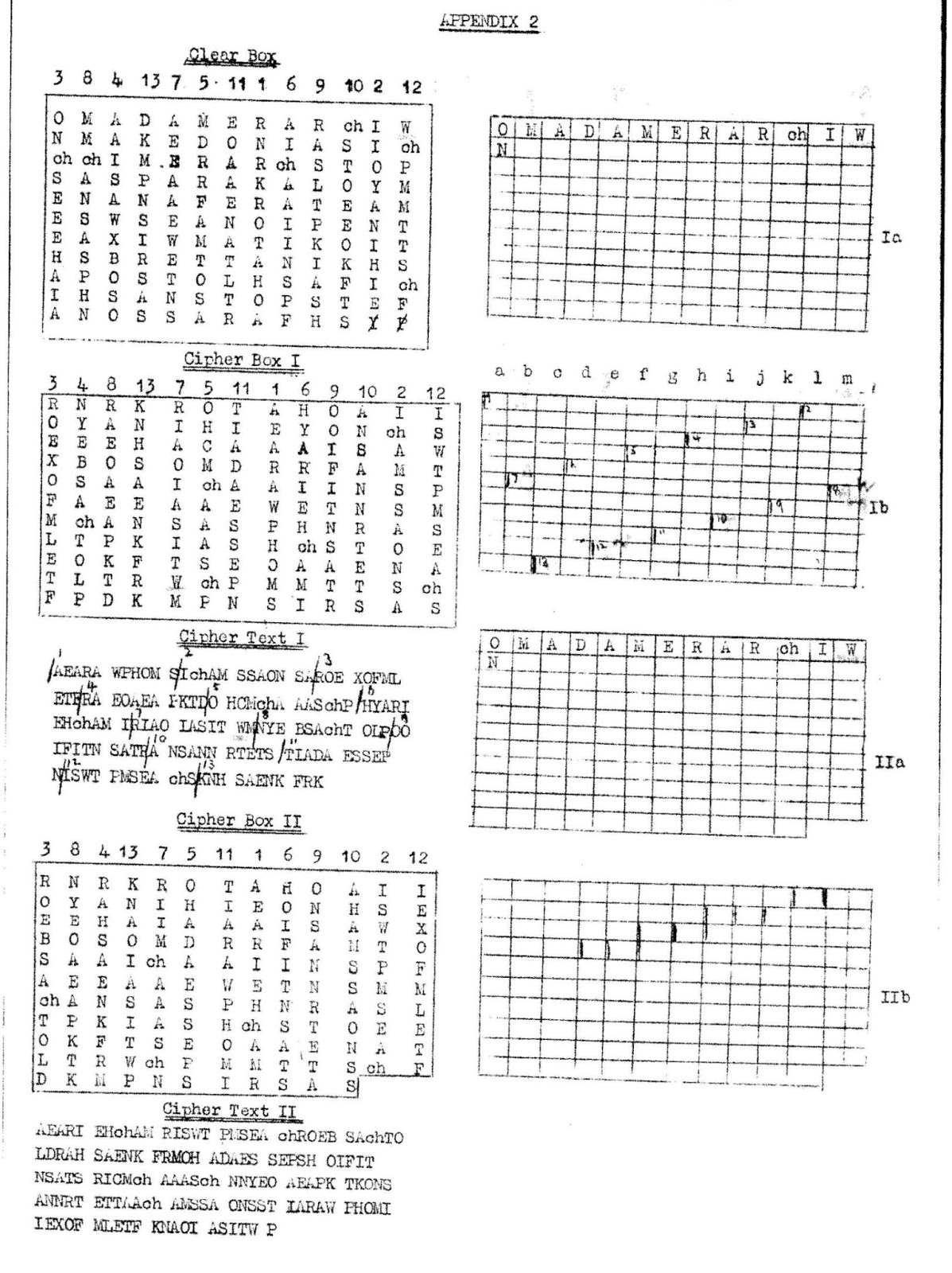
1). In TICOM report I-170, p9 an example is given of the ELAS double transposition cipher. 

The sample message reads:


OMADA MERARchIWN MAKEDONIAS ch ch ch IMERA ch  STOP SAS PARAKALOYME NA ANAFERATE AMESWS EAN OI PENTE AXIWMATIKOI THS BRETTANIKHS APOSTOLHS AFIchHSAN STOP STEFANOS SARAFHS YF

My translation: ‘For Macedonian group of divisions – Day – STOP we request that you report immediately if the five officers of the British mission have arrived STOP Stefanos Sarafis’.

Stefanos Sarafis was the military commander of the ELAS forces.

2). It seems that the Greek communist military forces continued to use insecure cipher systems even in the late 1940’s. An FBI report dated August 1950 (4) says the AFSA (Armed Forces Security Agency) was working on the following Greek communist crypto systems:


These were monome-dinome substitution (enciphered with additive) and single and double transposition, similar in concept to the systems used in 1944.

It is reasonable to assume that the use of insecure ciphers by the communists was exploited by the Greek Army and US agencies during the Greek Civil War.

Acknowledgments: I have to thank Frode Weierud for translating the KONA 4 summaries and Randy Rezabek for sharing his copies. 

Thursday, May 25, 2017

Interesting information in TICOM report I-170

The NSA has declassified the TICOM report I-170 ‘Report on French and Greek Systems by Oberwachtmeister Dr. Otto Karl Winkler of OKH/FNAST 4’ (dated January 1946).


I’ll probably write a more detailed essay on the compromise of Greek military, diplomatic and partisan codes in WWII.

Some interesting excerpts from the report:

My first employment was on the breaking and translating of Greek Air Force messages in Spring 1941. The unit was in BUCHAREST at that time and later it was at BANJA KOSTENIC in Bulgaria. C.O. was Hptm. SCHMIDT, head of the cryptography and translation department from then until Autumn 1944 was Prof. Alfred KNESCHKE, a Professor of Mathematics from Saxony.

……………………………………………………………

Greek Army and Navy messages were not broken until after the conquest of Greece, when captured ‘Codes’ were read during the attack on Crete.

……………………………………………………………

In May 1941 the unit moved to ATHENS. In the autumn of that year the De Gaulle troops in Syria began to send cipher messages. ………………………………………………… Practically the whole Syrian WT traffic was read and a complete picture obtained of the build-up, strength, composition and Organization of the French armed forces, of the political administration and the names of all important personalities, as well as all changes and troops movements. In charge of evaluation of French material at this time was Wm. KÜHNAPFEL (from KONIGSBERG).

As the French used also to refer to British troop movements and officer personalities from time to time, such pointers were of considerable use to our English evaluation section, as the British ciphers could not as a rule be broken by German Sigint.

……………………………………………………………

The unit moved to BELGRADE in Autumn 1943, thence, in August 1944 to PERNITZ near WIENER NEUSTADT, However, I received a new task in Spring 1944 with the appearance of Greek messages sent by ELAS. In the course of our two year stay in Athens I had been able to learn modern Greek almost perfectly, on the basis of a knowledge of classical Greek and spurred on by love for and interest in Greece. In addition my duties had provided me with a certain experience of cryptography and a good translation technique. Thus I was put in charge of Greek cryptography and was assisted in the actual cryptographic work by Uffz. Diether STROBL from BERLIN, an English interpreter and technical student. I had held the rank of Wachtmeister since Christmas 1943.

……………………………………………………………

Double transpositions are regarded as a secure type of cipher and are therefore used by many British agents. To the best of my knowledge the unit never succeeded in breaking one and only occasional captured material has rendered it possible to read some traffic retrospectively. For the sake of security it is essential to avoid using complete or even square boxes, typical beginnings or endings of messages and constantly recurring addresses and signatures, to use each key as little as possible and as far as possible to have different keys for each box of the pairs The Greeks overlooked all these rules right up to the end, with the result that messages in the same setting and with the same number of groups (Elementeanzahl) cropped up.

……………………………………………………………

In any case we succeeded in breaking 50 – 60% of the traffic tackled and as important messages were always retransmitted on several links with different keys, we were able to build up an almost complete picture of the build-up, organization and composition of EAM and ELAS, to compile lists of their leading personalities and officers and to inform the competent German political and military authorities in good time about many planned military and political actions, acts of sabotage, ambushes, dynamitings, etc. I can only remember a few details and cannot reproduce examples systematically as the evaluation of the material wan not my job, which consisted only of deciphering, decoding and translating the available material.

Sunday, August 2, 2015

Allied agents codes and Referat 12

In the course of WWII both the Allies and the Axis powers were able to gain information of great value from reading their enemies secret communications. In Britain the codebreakers of Bletchley Park solved several enemy systems with the most important ones being the German Enigma and Tunny cipher machines and the Italian C-38m. Codebreaking played a role in the Battle of the Atlantic, the North Africa Campaign and the Normandy invasion. 

In the United States the Army and Navy codebreakers solved many Japanese cryptosystems and used this advantage in battle. The great victory at Midway would probably not have been possible if the Americans had not solved the Japanese Navy’s JN25 code.
On the other side of the hill the codebreakers of Germany, JapanItaly and Finland also solved many important enemy cryptosystems both military and diplomatic. The German codebreakers could eavesdrop on the radio-telephone conversations of Franklin Roosevelt and Winston Churchill, they could decode the messages of the British and US Navies during their convoy operations in the Atlantic and together with the Japanese and Finns they could solve State Department messages (both low and high level)  from embassies around the world.

Radio intelligence and codebreaking played an important role not only in the military and diplomatic fields but also in the shadow war between the Allied intelligence agencies, the European Resistance movements and the German security services. In the period 1939-41 German troops conquered most of continental Europe and the occupied countries were forced to contribute to the Axis effort by sending raw materials, agricultural products and forced labor to Germany. Thanks to the blockade of German occupied Europe by the Royal Navy and the harsh demands of the German authorities life in the occupied areas was bleak. Discontent over German occupation led many people to join resistance movements and oppose the authorities, either by printing and distributing anti-Axis leaflets and books, by sabotaging war production or by directly attacking the German troops and their collaborators in the government and the civil service.

Monday, July 28, 2014

Svetova Revoluce and the codes of the Czechoslovak resistance

At the end of the First World War the multiethnic Austro-Hungarian Empire collapsed and out of its ruins emerged several new countries. One of these was Czechoslovakia, containing the Czech areas of Bohemia and Moravia together with Slovakia and Carpathian Ruthenia in the east.

In the interwar period Czechoslovakia followed a foreign policy supportive of France and was part of the Little Entente. The country had a stable democracy and its industrial resources were large (based on the Skoda works) for such a small country. However there were two important problems affecting Czech national security. On the one hand the rise of Nazi Germany and its rearmament was a clear security threat. At the same time there were serious problems with the German and Slovak minorities that resented Czech rule.  

Czechoslovakia contained a large number of minorities that were dissatisfied with the ruling Czech establishment. Especially the German minority made up roughly 23% of the population (according to the 1921 census) and a large part of it was concentrated in the border with Germany called Sudetenland. Many of the Sudeten Germans wanted for their areas to be unified with Germany and in the 1930’s Hitler’s Germany supported the demands of the Sudeten German Party. These claims were rejected by the Czech government of Edvard Beneš and as the Czech crisis threatened Europe with a new war a conference took place in Munich between the governments of Germany, Italy, Britain and France 

Without support from Britain and France the Czech government was forced to cede the Sudeten territories to Germany and also lost other disputed areas to Hungary and Poland. Even though Germany had succeeded in absorbing the Sudeten areas and in weakening Czechoslovakia that did not stop Hitler’s offensive plans and in March 1939 German troops invaded and occupied the rest of the country. From then on the country was ruled by Germany and special attention was given to its heavy industry which produced weapons for the German armed forces.
During the war the Czech Government in Exile, headed by Beneš, was based in London and had regular communications with the Czech resistance. The most daring operation of the resistance was the assassination of Reinhard Heydrich, protector of Bohemia and Moravia and former head of the Reich Main Security Office. However after this episode the Germans took many security measures and were generally able to keep the resistance activities under control. In this area they took advantage of the insecure communications between the resistance and the Czech intelligence service, operating from Britain.

Tuesday, July 22, 2014

Compromise of Soviet codes in WWII

Signals intelligence and codebreaking played an important role in WWII. British and American codebreakers solved many important Axis crypto systems, such as the German Enigma machine and the Japanese Navy’s code JN25. 

Historians have not only acknowledged these Allied successes but they’ve probably exaggerated their importance in the actual campaigns of the war.
Unfortunately the work of the Axis codebreakers hasn’t received similar attention. As I’ve mentioned in my piece Acknowledging failures of crypto security all the participants suffered setbacks from weak/compromised codes and they all had some successes with enemy systems. 

Britain, the Soviet Union and the United States did not have impenetrable codes. In the course of WWII all three suffered setbacks from their compromised communications.
After having dealt with the United States and Britain it’s time to have a look at the Soviet Union and their worst failures. 

Move along comrade, nothing to see here
Compromises of communications security are usually difficult to acknowledge by the countries that suffer them. For example since the 1970’s countless books have been written about the successes of Bletchley Park, yet detailed information on the German solution of Allied codes only started to become available in the 2000’s when TICOM reports and other relevant documents were released to the public archives by the US and UK authorities.

In Russia the compromise of their codes during WWII has not yet been officially acknowledged and the archives of the codebreaking organizations have remained closed to researchers. This is a continuation of the Soviet policy of secrecy.
The Soviet Union was a secretive society and information was tightly controlled by the ruling elite. This means that history books avoided topics that embarrassed the regime and instead presented the officially sanctioned version of history. Soviet era histories of WWII avoided references to codes and ciphers and instead talked about ‘radio-electronic combat’ which dealt with direction finding, traffic analysis and jamming (1).

After the fall of the Soviet Union several important government archives were opened to researchers and this information has been incorporated in new books and studies of WWII. However similar advances haven’t taken place in the fields of signals intelligence and cryptologic history. Unlike the US and UK that have admitted at least some of their communications security failures the official line in Russia is that high level Soviet codes were unbreakable and only unimportant tactical codes could be read by the Germans. Even new books and studies on cryptology repeat these statements (2).
However various sources such as the TICOM reports, the war diary of the German Army’s signal intelligence agency Inspectorate 7/VI and the monthly reports of the cryptanalytic centre in the East Horchleitstelle Ost clearly show that the Germans could solve even high level Soviet military and NKVD codes.

Wednesday, April 17, 2013

The secret messages of Marshall Tito and General Mihailović

The Kingdom of Yugoslavia was one of the states that were created when the old Austro-Hungarian empire collapsed at the end of WWI. The country covered a large area in the Balkans but was politically unstable since it was made up of a diverse group of peoples (Serbs, Croats, Slovenes, Montenegrins).

Yugoslavia was part of the Little Entente organized by France. Although its foreign policy was pro-Allied it did not declare war on Germany in 1939. The defeat of France in 1940 caught the Yugoslav leaders by surprise and forced them to adopt a pro Axis policy. This change however was opposed by a group of military officers and in March 1941 a coup replaced the regent Prince Paul with General Dušan Simović. This maneuver (thought to be organized by the British) infuriated Hitler and he ordered that the country was to be destroyed as a political entity. In April Yugoslav troops were quickly overrun by German forces and a period of occupation and internal strife began.
During the occupation the old antagonisms between ethnicities (Serbs vs Croats) and political movements (Right vs Left) resurfaced and led to a multisided civil war. The Chetniks of General Mihailović fought the Communist Partisans of Marshall Tito and both attacked the collaborationist government of Milan Nedic, the German and Italian occupation troops and the Croat forces of Ante Pavelić.

All sides took to heart the motto ‘the enemy of my enemy is my friend’. This meant that at times some resistance group would make a deal with the occupation authorities and agree to leave them alone so both could attack another group. The results of this widespread conflict were mass destruction of property and loss of lives as each group attacked the villages that supported their enemies.
During the period 1941-44 the Germans mounted major operations against the resistance movements but they could not destroy them. In their war against the Chetniks and the Partisans however they took advantage of signals intelligence. The resistance groups used codes that could not withstand a serious cryptanalytic attack and their cipher clerks made many mistakes that facilitated solution. By reading the traffic of Tito and Mihailović the Germans could build up the OOB of their organizations, identify important personalities and anticipate enemy operations.

At the same time the British also used cryptanalysis in order to monitor the internal Yugoslav situation and decide which resistance group they should give supplies to. Their ability to decode the Enigma cipher machine meant that they could use German military messages to see if the information coming from the Chetniks and the Partisans was corroborated by official German reports. They also read Chetnik and Partisan messages including the clandestine traffic between Moscow and Tito (this program was called ISCOT).

Monday, October 15, 2012

German counterintelligence operations in occupied France

After the fall of France in the summer of 1940 the country had to endure four long years of occupation under the German forces. During that period countless resistance groups were organized both by the French and by foreign powers.

The agencies that organized resistance groups were the British SIS and SOE, the intelligence service of the Free French and the Polish intelligence service. In addition there were the homegrown resistance groups plus the intelligence service of the Vichy regime.
Relations between these groups were complicated. For example the Vichy intelligence service helped the resistance but was at odds with the De Gaule movement, the communists distrusted the right-wingers and there was little cooperation between the British SOE and SIS.

The German agencies whose task it was to monitor and destroy the Resistance were also numerous. There was the military police Geheime Feldpolizei, the military intelligence service Abwehr, the Security Services Sicherheitsdienst/Gestapo and the Radio Defense departments of the Armed Forces and the Police.
Initially the resistance was made up of a few isolated groups organized by patriotic individuals. They did not take many security precautions and as a result their groups were easily infiltrated by agents. As time went on the groups that took their place were better organized and had regular contact with London via radio. They also received weapons, money and explosives from airdrops.  In some cases these weapons were used for acts of sabotage but the majority were stored away for use on the day of the Allied invasion.

Considering the anti-German attitude of the French population and the geographical proximity of Britain one would expect that setting up resistance groups and organizing them would not be hard. Unfortunately for the Allies this was not so. The Germans were hampered by their separate security agencies but they were able to identify, monitor and destroy countless resistance groups. In many cases they managed to gain control of whole groups by maneuvering their agents into top positions.
They also engaged in radio-games with the British. After capturing radio operators and their cipher material they sent misleading reports to London and got the British to reveal parts of their networks or drop supplies and agents into their hands.

In 1941-42 their main successes were the liquidation of the INTERALLIÉ, AUTOGIRO, CARTE networks and the arrest of key members of ALLIANCE. In August ’42 they carried out an extensive radio finding operation in Vichy France called operation ‘Donar’. Depending on the source they neutralized 6 or 12 enemy transmitters.
In 1943 the Germans achieved their greatest successes against the Resistance.  They compromised the SPINDLE group and arrested Roger Frager, Peter Churchill and Odette Sansom. They captured the leadership of the ORA-Organisation de résistance de l'armée and many of their members. They also captured general Delestraint, head of the Armée secrète. When Resistance leaders met in order to unify their groups the house was raided by the Germans thus capturing many top level people, including prefect Jean Moulin. In the summer of ‘43 the SOE’s largest network in France PHYSICIAN/PROSPER was liquidated. Also in ’43 the ARCHDEACON network was thoroughly compromised and many groups of the Gaullist MITHRIDATE organization were destroyed.

Despite all their efforts by 1944 the Resistance had grown exponentially. With Germany’s defeat in sight everyone was willing to help the resistance groups and even German agents crossed over and attacked their former masters, giving rise to the term ‘resistant du 44’.
Still their successes against so many different organizations deserve to be recognized. Why were the Germans so successful in counterintelligence work?

1). Sabotage vs espionage operations
The mission of an intelligence agency is to keep its existence secret and collect information. For these operations only a small number of highly trained operatives are needed. On the other hand an organization tasked with sabotage will need arms shipments, arms depots and lots of agents to move arms and explosives around and take part in attacks. Obviously such activity cannot remain in the dark as attacks on infrastructure and personnel will attract the attention of enemy security services.

In essence this was the problem of SOE (Special Operations Executive). Unlike SIS that always kept a low profile SOE was created to attack the German occupation authorities and destroy critical infrastructure in occupied countries. This meant that its networks quickly became a target for the Germans.
2). Antagonism between the Allies

Relations between the different Allied agencies were antagonistic. SIS was an established organization and had no reason to support the upstart SOE. The Free French distrusted the British and were in turn distrusted by them. Vichy authorities were willing to turn a blind eye to British operations but they hated De Gaulle’s people.
The effects of having many different organizations operating in France meant that the Resistance was fragmented.

3). Poor security procedures
Security was not a high priority in the resistance groups. The resistance people frequented the same areas (bars/cafes/restaurants) thus making it easy for the Germans to keep them under observation. Instead of trying to keep their identities secret some people openly boasted of being resistance members or showed of their weapons in night clubs. The size of the resistance groups was also a security problem. With hundreds of members it was impossible to keep double agents out.

One of the worst errors was the use of the same radio operator by several resistance groups. Each group had one or more radio teams but these were often arrested and when that happened there was no other means of communication with London. The proper procedure would be to wait for a new operator to arrive but what actually happened was that another network was asked to transmit their messages. Since there were many networks but few radio operators this meant that the ones under German control could compromise several resistance groups.
Serious security errors were also committed by the British. Radio operators were given a series of security checks to insert into their messages so they could inform on whether they were under German control. In many cases these checks were disregarded by SOE as mistakes of the operator. This is not as ridiculous as it sounds. Messages from the field had many errors and in a lot of cases were either completely unreadable or had to be solved cryptanalytically. Under these circumstances it was not possible to determine if the security checks were inserted correctly or were mistakes.

4). Psychological manipulation
The German security services have a reputation of torturing people but the reality is that in most cases they relied on psychological manipulation and not physical violence. Although prisoners were sometimes maltreated (especially by the SD) usually confessions were gotten out of them by showing them how much was already known about their networks.

Many people were enticed to work for the Germans in exchange for protection for themselves and their families.
For high level operatives a deal was proposed. If they gave up the names and addresses of the members of their entire network the Germans would guarantee that their people would not be executed but only imprisoned. Many resistance leaders took this deal.

5). Abwehr vs Sicherheitsdienst
For the Germans the existence of military and political security services was both a hindrance and an asset.

On the one hand the military intelligence service Abwehr often clashed with the political Security services (Sicherheitsdienst/Gestapo). There was undoubtedly duplication of effort and wasted manpower. In some cases one agency would arrest people who worked for the other thus compromising secret operations.
On the other hand each agency had a reputation that attracted specific kinds of people. The Abwehr was lead by military officers who had a code of honor and did not like torture. They tried to recruit agents by mutually beneficial deals. For example a resistance member serving a long sentence would be given the offer to be released in exchange for becoming a spy. In other cases someone could save a family member who was sentenced to death by revealing information about the resistance. These deals were honored by the Abwehr.

The Sicherheitsdienst did not have many moral scruples. What mattered for them were results. For that reason they were prepared to use torture, extortion and bribes. People who wanted to make money could offer their services and act as provocateurs. Criminal elements like the notorious Bony-Lafont gang worked for the SD.
An interesting trick by the Abwehr was to use the SD as a boogeyman. Prisoners knew that the Abwehr usually treated prisoners with respect. On the other hand the SD had a reputation for torture. If a difficult prisoner refused to give any information then the Abwehr interrogator would tell him ‘well there’s nothing more I can do for you, we’ll have to send you to the SD’. This got many men talking.

6). Skillful use of double agents
The Germans successfully inserted double agents in the resistance groups. Some of their most successful agents were:

The Cat
Mathilde Carré alias ‘La Chatte’ was a founding member of INTERALLIÉ. It seems that she was romantically attached to Roman Czerniawski. In November 1941 she was arrested and revealed the secrets of INTERALLIÉ to the Germans. She became a double agent for Bleicher and compromised many members of the resistance. She also compromised Pierre de Vomécourt’s AUTOGIRO network when she convinced him to use her radio operator for his messages.

Vomécourt suspected her of being a spy and when they travelled to London together in February 1942 he had her arrested. She spent the rest of the war in jail.

Roger Bardet
Bardet was a member of CARTE. In 1943 he was tricked by Bleicher to come to Paris with him and visit his chief Marsac who was in prison. Bardet was then arrested and after spending time in jail offered to work for the Germans. He eventually became Henri Fragers second in command in the DONKEYMAN network. In 1944 he betrayed Frager and provided Bleicher with the BBC’s pre-invasion ‘Action’ messages. With the German defeat in sight he changed sides once more and attacked the Germans. He was arrested at the end of the war.

The mystery of ‘Gilbert’
Henry Dericourt alias ‘Gilbert’ was a civilian pilot who served with the French AF in the Battle of France.  In 1943 he was approached by SOE and given the task to smuggle agents into France by plane. Dericourt carried out this mission with great success but eventually came under suspicion of passing information to the Germans and for that reason he was recalled to London in February 1944. According to his postwar interrogation to the French authorities he did give some information to the Germans. The truth is that Dericourt cooperated with Sturmbahnfuehrer Boemelburg in exchange for protection for himself, his family and his agents. That is probably the reason for his excellent flying record (43 people flown in and 67 flown out of France without problems).

It seems that through him the Germans were able to make copies of the documents being transported from France to London. These documents were later shown to captured agents thus breaking their confidence in the security of their organization.
Was ‘Gilbert’ a traitor? He did give information to the Germans but in his trial in 1948 Boddington head of the SOE France section came to his defense.

Dericourt took his secrets to the grave as he died in a plane accident in 1962.
7). Insecure communications

A serious problem for the Allied spy networks were the limited means of communication between them and London. Mail could be transported by plane or by ship across the Channel. In addition there was a southern route into Spain. The Germans occasionally captured couriers and their messages. They also had Dericourt as a source of mail.
The only means of rapid communications were by radio but this was a double edged sword. Radio transmissions could be also picked up by the Germans and if they could solve the codes then they could identify the agents.

Intelligence agencies have a reason to favor the use of unbreakable codes such as the one time pad. A military message is usually not important on its own. A decrypted message of a resistance group however could contain names and addresses which were enough to allow the Germans to arrest people and unravel whole groups.
Unfortunately for the Allies the code systems used by SOE and the Poles for much of the war were theoretically and practically vulnerable to cryptanalysis.

The crypto-systems used by SOE were initially substitution systems employing a poem as a ‘key’ or a passage from a book as a cipher. These were insecure and Leo Marks head of the SOE cipher department had them changed to OTP.
The Polish secret service in France used in 1943/44 a stencil cipher that was much more secure than the SOE substitution systems but it too succumbed to Germans analysis.

Radio Defence Corps and Referat Vauck
The German agencies responsible for monitoring illicit radio transmissions were the Radio Defence Corps of the Armed Forces High Command – OKW Funkabwehr and the similar department of the regular police – Ordnungspolizei. Both agencies operated in France but they were assigned different areas. 

These agencies not only monitored the agents’ traffic but in many cases they were able to locate the site of transmissions through D/F (direction finding). In such cases the radio center was raided and often the operator and his cipher material were captured.
This cipher material was then used by Dr Vaucks agents section to identify the crypto-systems, solve them and decode the traffic. This section, headed by Dr Wilhelm Vauck, was originally part of the Army’s signal intelligence agency OKH/In 7/VI but worked closely with the Radio Defense Corps. It was established in 1942 and by the end of the year two-man teams were detached to regional Aussenstellen in Paris, Marseilles, Lyons, Prague, Oslo, Vienna, Brussels. In late 1943 the entire department was moved to the OKW Funkabwehr.

According to postwar reports they usually had success with a system if it had been physically compromised. However in some cases it was possible to solve enemy systems cryptanalytically. Mettig, head of the Army’s signal intelligence agency in 1941-43 says in TICOM I-115 that
a special weakness of Allied agents’ ciphers was the use of books for enciphering. Usually only a minor inroad or other clue was required to reproduce a piece of the cipher text and conclusions could thence be drawn as to which book was used. In the case of one Allied transmission in the summer of ’42, five or six French words of a text were ascertained, leading to the conclusion that the cipher book dealt with the Spanish civil war. In view of this assumption, all French books about the Spanish civil war in the State libraries of Paris, Madrid and Lisbon were read with the object of trying in these 5-6 words. The book was found. PW always looked on a great research effort as worthwhile. The greatest weakness in using books for enciphering lay in the fact that, once a book had been compromised, an entire transmission could be broken automatically. The weakness existed even if the book in question could not be secured in the same edition or impression. It was still possible for Referat Vauck (though again only after considerable research) to find the right place in the book and to secure a fluent deciphering system by means of conversion tables.

Another weakness of Allied agent ciphers was the use of poetry. Here the verse metre was an additional help in solving the cipher text, as was done in the case of a Czech transmission in the autumn of 42/43.’

The monthly reports of Referat 12, included in the War Diary of Inspectorate 7/VI, show that in the period 1942-44 messages from spy networks in France and Belgium were continuously decoded and several ‘radiogames’ were carried out by the security services.

Playback/Funkspiel
When the agents’ radio and the cipher material were captured then the Germans could start a radiogame. By impersonating the radio operator (or forcing him to take part in the deception) they sent and received messages and were able to deceive the British about the true state of their network. Through these operations the Germans learned of the enemy agency’s organization, plans and  personalities.

The most famous episode in this secret war was the radiogame in Holland called operation ‘Nordpol’. There the Germans were able to trick the British into believing that the Dutch resistance was very effective while in reality the whole network was under their control.
In France too they had many similar successes. For example in 1941 they captured and used in a radio game the operator of ALLIANCE and in 1943 did the same with the operator of PHYSICIAN. In the same year they gained control of ARCHDEACON and had the British parachute arms and agents into their hands.

According to TICOM I-115 before the Allied invasion they had 12 radio links under their control passing disinformation to London.

In addition the Sonderkommando Rote Kapelle (Special Detachment Red Orchestra) was able to dismantle the illicit radio network of the French Communist party and replace it with a new network under its control. The members of the resistance and the communist party working for this organization became unwitting pawns of the Germans.
8). Limits of ULTRA

The solution of German ciphers was one of the greatest successes of the Allied side. The intelligence gained from reading enemy messages played an important role in the war.
However the British were only able to intercept messages sent by radio. In Western Europe the Germans relied on the landlines. Some messages of the Abwehr and the police were sent by radio and decoded by Bletchley Park but the vast majority stayed of the air.

British intelligence in the Second World War vol5 says ‘Certain communications, of course, remained secure throughout the war. All internal communications within the Reich that went by land-line, as did those between the Asts and Abwehr HQ, and between Abwehr HQ and OKW, fell within that category.
British intelligence in the Second World War vol2 says about police ciphers: ‘In contrast to the wealth of information it provided from eastern Europe, the police traffic revealed little about conditions in France, Belgium, Holland, Denmark, Norway and Greece until late in the war. This situation reflected the greater availability of land-lines and the fact that the police played a smaller part in occupation duties than they did in the east, the army taking the brunt, but it was also a consequence of the absence of widespread partisan warfare in these areas before 1944.

In addition the Enigma key of the Sicherheitsdienst/Gestapo – TGD was not broken during the war. The ‘History of Hut 6’, vol2 says It never cilied so far as we know and no convincing re-encodement from any other key was ever produced’.
Conclusion

When the Germans occupied France in 1940 they were not ready to deal with underground resistance movements. Their personnel lacked special training and they did not have well organized intelligence networks in place. Their efforts were amateurish and initially they were helped by elementary security errors of the resistance people. In due time however members of the Abwehr and the Sicherheitsdienst were able to ‘learn on the job’ and they became very efficient at uncovering enemy groups and turning around agents.
Even though they had to operate in a country with an anti-German population they still infiltrated and destroyed many large resistance networks. In many cases they were able to gain control of their radio communications and trick the British into sending them arms and agents.

Despite all their efforts the Resistance grew like a hydra. No matter how many networks the Germans destroyed new ones grew to take their place. By 1944 everyone knew that Germany would lose the war and even their own agents started abandoning them.
In the period 1941-44 however countless German lives and critical infrastructure were saved thanks to the efficient work of the German counterintelligence agencies. Up until 1944 the Resistance was kept at a tolerable level.

The successes of the German security agencies versus French, British and Polish resistance networks in occupied France are worthy of recognition.

Overview of important groups and personalities

INTERALLIÉ network: Founded by Roman Czerniawski/’Armand’, controlled by SIS. Most of the members were displaced Poles. Compromised by Mathilde Carre.

le réseau AUTOGIRO, dirigé par Pierre de Vomécourt « Lucas », dépendant du Special Operations Executive , section F.AUTOGIRO network: Organized by Peter Vomécourt ‘Lucas’, controlled by SOE. Compromised by Mathilde Carre.

CARTE network: Organized by André Girard.  Compromised when Marsac lost the membership list in late ’42.

ALLIANCE network: Organized by Georges Loustaunau-Lacau, controlled by SIS. In 1941 their radio operator was captured by the Germans and used in a radiogame. As a result Loustaunau-Lacau and key members of the organization were arrested in 1941 and 4 of the group’s 6 radio transmitters were captured. Despite the setback the group continued to operate.

le réseau SPINDLE, dirigé par Peter Churchill « Raoul », dépendant du Special Operations Executive , section F.SPINDLE network: Organized by Peter Churchill - ‘Raoul’, controlled by SOE. Compromised by Marsac.

PHYSICIAN/PROSPER network: Organized by Francis Alfred Suttill, controlled by SOE. In 1943 was the largest SOE network in France. Liquidated in summer ’43. Depending on the source 500-1.500 people were arrested.

le réseau DONKEYMAN, dirigé par Henri Frager « Jean-Marie », dépendant du Special Operations Executive , section F.DONKEYMAN network: Organized by Henri Frager - ‘Paul’, controlled by SOE. Compromised by Roger Bardet.

SCIENTIST: SOE network in Normandy. Compromised by the Germans.

ARCHDEACON network: SOE network compromised from the start by the Germans. Used by SFHQ-Special Forces HQ for infiltrating new teams. Resulted in at least 18 agents lost.

ORA - Organisation de résistance de l'armée : Organized by Vichy officers in early ’43, following the German occupation of Vichy France in November ’42. Leadership captured in June ’43.

Armée secrète - Gaullist resistance organization. United the groups ‘Combat’, ‘Libération’ and ‘Franc-Tireur’.

MITHRIDATE - Gaullist network. In 1943 several hundred members were arrested by the Sicherheitsdienst. In late ’43 the group’s codes were compromised and the internal organization revealed. The headquarters in Paris were raided and Colonel Pierre Herbinger, head of the organization arrested in May ‘44. The group was also compromised through their collaboration with a Rote Kapelle network controlled by the Germans.

General Delestraint: Head of Gaullist network Armée secrète. Arrested in June ’43.

General Frère: Head of ORA organization. Arrested in June ’43.

Jean Moulin: Prefect of Eure-et-Loir and symbol of the resistance. Organizer of Armée secrète. Arrested in June 1943 when the Germans raided a meeting of several Resistance leaders. Was tortured by Klaus Barbie and died en route to Paris.


Emile Bollaert: Replaced Jean Moulin as General Delegate of the French Committee of National Liberation in September 1943. Was arrested in February ’44.


Pierre Brossolette: One of the major leaders of the resistance. Became a member of the Council of the Order of the Liberation. Was arrested with Emile Bollaert in February ’44.


Forest Yeo-Thomas - ‘White rabbit’: Deputy Head of SOE RF (Free French) section. Captured in March ’44 while organizing the rescue of Brossolette and Bollaert.

Roman Czerniawski - ‘Armand’: Polish officer, organizer of the INTERALLIÉ network. Arrested in November ’41. Agreed to spy for the Germans and was allowed to escape. Once he reached London he informed the British and was used to pass disinformation to the Germans.

Mathilde Carre - ‘La Chatte’: Member of INTERALLIÉ. Romantically attached to Czerniawski. Arrested in November 1941 and subsequently betrayed him and worked for the Germans. Compromised Raoul Kiffer. Convinced de Vomécourt to send messages through her radio operator (controlled by the Germans). In February ’42 she went to London with de Vomécourt but her role had been uncovered and she spent the rest of the war in jail.

Raoul Kiffer - ‘Kiki’: Member of INTERALLIÉ. Betrayed by Mathilde Carre and later became a German spy. Organized a resistance group in the Lisieux area in Normandy. The group was controlled by the Abwehr but eventually became a security risk and was liquidated by the SD.

Georges Loustaunau-Lacau: Ex military officer and right-wing political figure. Organizer of the ALLIANCE network. Arrested by the Vichy police in 1941 and handed over to the Germans along with key members of his organization.

André Girard: organizer of the CARTE network located in the South of France. His organization was fatally compromised when the Germans captured a membership list in late ’42. Was able to escape to the UK.

Andre Marsac: member of CARTE. Lost the organization’s membership roll during a train trip in November ’42. He was arrested by the Abwehr in March ‘43. Hugo Bleicher managed to convince him that he was opposed to the Nazi regime thus getting him to reveal details about the SPINDLE group. Thanks to this deception Roger Bardet, Odette Sansom and Peter Churchill were eventually arrested.

Roger Bardet: member of the CARTE group. Was lured to Paris and arrested by Bleicher. Eventually became a German spy inside the Resistance. Managed to become second in command for Henri Frager and thus compromised the DONKEYMAN network. In 1944 changed sides once more and fought against the Germans. At the end of the war arrested and tried for treason.

Peter Churchill - ‘Raoul’: SOE agent. Organizer of SPINDLE group. Arrested in April 1943 by Bleicher.

Henri Frager - ‘Paul’: Second in command of the CARTE group, then became head of the DONKEYMAN network. Suspected Dericourt of being a German spy and informed the British thus getting him recalled to London. Eventually betrayed by Bardet, he was arrested in August ’44 and executed in October.

Henri Dericourt - ‘Gilbert’: French pilot who became the SOE’s air transport officer. Successfully transported agents in and out of France but came under suspicion of working for the Germans. He was recalled to London in February 1944 and interrogated. He admitted giving information to the enemy. After the war was tried in France but acquitted thanks to the testimony of Boddington head of SOE France section.

Pierre de Vomécourt: Organizer of the AUTOGIRO network. In October and November ’41 his radio operators were arrested forcing him to use the INTERALLIÉ radio link for contacting London. Since this was under German control his own network was compromised. Visited London with Mathilde Carre in February ’42 and had her arrested. Returned to France but was himself arrested in April ’42.

Francis Alfred Suttill - ‘Prosper’: Organizer of the PHYSICIAN network (also called PROSPER) covering Paris. The whole network was destroyed in summer ’43 and Suttill arrested in June. Agreed to give information to the Germans in exchange for protection for his agents.

Gilbert Norman - ‘Archambaud’: Radio operator of the PROSPER network. Arrested in June’43. Cooperated with the Germans.

John Starr - Organizer of the ACROBAT network, controlled by SOE. Arrested July ’43. Cooperated with the Germans.

André Grandclément: Organizer of SCIENTIST. Became a German agent.

Harold Cole: British national. Originally part of the MI9 organization, helping Allied airmen escape from occupied Europe. However after his arrest in 1941 he worked for the Germans thus compromising many Allied escape routes.

Bony-Lafont gang: Ex police inspector Pierre Bony and gangster Henri Lafont organized a group that hunted down Resistance members and turned them over to the Germans. The gang were infamous for their use of torture and extortion.

German personnel

Oscar Reile - Head of Abwehr Counterintelligence in France. Operated from the luxurious Hotel Lutetia in Paris.

Karl Boemelburg - SS Sturmbahnfuehrer. Gestapo commander.

Hans Kieffer - SS Sturmbahnfuehrer. Sicherheitsdienst commander.

Klaus Barbie: Head of Gestapo Lyons. Infamous for his use of torture.

Hugo Bleicher - Initially member of the Geheime Feldpolizei. Was transferred to the Abwehr where he became an expert in recruiting double agents.

Goetz - Expert in radiogames.

Freyer - Head of the Funkabwehr’s Aussenstelle Paris in 1943/44.

Sources: ‘The German Penetration of SOE: France 1941-1944’, ‘Secret War: The Story of SOE, Britain's Wartime Sabotage Organization’, ‘Colonel Henri's story: the war memoirs of Hugo Bleicher’, CSDIC SIR 1719 - 'Notes on Leitstelle III West Fur Frontaufklarung', CSDIC/CMF/SD 80 - 'First Detailed Interrogation Report on LENTZ, Waldemar, and KURFESS, Hans', HW 34/2 ‘The Funkabwehr’, TICOM I-115 'Further Interrogation of Oberstlt METTIG of OKW/Chi on the German Wireless Security Service (Funkuberwachung), ‘European Axis Signal Intelligence in World War II’ vol4, ‘War Secrets in the Ether’, ‘History of Hut 6’ vol2,  ‘British intelligence in the Second World War’ vols 2 and 5, Wikipedia, ordredelaliberation.fr