Showing posts with label Axis codebreakers. Show all posts
Showing posts with label Axis codebreakers. Show all posts
Monday, May 4, 2020
Interesting article on Japanese intelligence operations
International Journal of Intelligence and
CounterIntelligence: ‘Japanese
Navy’s Tactical Intelligence Collection on the Eve of the Pacific War’ by Naoki
Saito.


Wednesday, March 11, 2020
List of TICOM I reports
Here is a list of the TICOM I reports 1-213. Thanks to Dermot Turing, who
copied the lists from NARA, it was possible to find the titles for almost all
of the reports.
I-1 Final Report on TICOM Team 3 on Final Exploitation on Burgscheidungen
I-2. Interrogation of Dr. Huettenhain and Dr. Fricke at Flenshurg,21 May 1945
I-3 Ubersicht der Russischen Chi verfahren
I-4 Record of conversation with Lt. Morgenroth
I-5 Report of Interrogation of Oberst Kettler on 21 May 1945
I-6 Interrogation of Lt. D. R. Muentz
I-6A Supplementary interrogation of Lt. D. R. Muentz
I-7 Statement of major McIntosh on Uffz. Graul
I-8 Conversation between TICOM team 6 and OKM 4/SKL III personnel
I-9 Notes on Kurier communications system
I-10 TICOM personnel lists (Brown list)
I-11 Allgemeine Aufgaben der Abteilung Funk.Opt.Signal und Erkennungsignale der 4/SKL II
I-12 Translation of the Preliminary Interrogation of O.R.R. Tranow of 4/SKL III/OKM, carried out at Flensburg on 24-25 May 1945 by T'ICOM Team 6
I-13 Composite Report on two Interrogations of Oberstlt. Friedrich, Chief of the G.A.F. Sigint Service, 18/5/45 and 9/6/45
I-14 TICOM personnel list (Brown list, revised)
I-15 Interrogation report of Oblt Schubert
I-16 Notes on interrogation of Amtsrat Schwabe and Obfkmstr Warsecha on Russian naval ciphers
I-17 Extracts of SHAEF interrogations of Maj. Gen. Boner, Colonel Grube, Lt. Col. Mettig, and Major Rottler.
I-18 Interrogations of Oberst Muegge, O.C. of NA 4 and NA 7 of German Army Sigint Service
I-19 A-G Report on Interrogation of KONA 1 at Revin, France, June 1945
I-20 Interrogation of Sondertuehrer Dr. Fricke of OKW/Chi
I-21 "Preliminary Interrogation of Oberst Kettler, R.R. Dr.Huettenhain , Sdf Dr. Fricke and ObIt. Schubert (OKH/Chi),15 June 1945
I-22 "Interrogation of German Cryptographers of Pers Z S Department of the Auswaertiges Amt
I-23 Interrogation of Major Ernst Hertzer, German Army Signals Intelligence Service (KONA 1).
I-24 Interrogation of members of OKM/ 4 SKL II on (a) soluble printing inks and (b) German-Japanese communications
I-25 Interrogation of five members of the RLM/Forschungsamt at Schloss Gluecksburg on 15, 21 June 1945
I-26 Interrogation of Oblt. Schubert (OKH/Chef HNW/Gen.d.NA) on Russian Military and Agents’ systems
I-27 Preliminary Interrogation of Fraeulein Hagen Head of English Section of Pers Z S, Auswaertiges Amt
I-28 Interrogation of Amtsrat Dr Stiehler of OKM 4/SKL II on German meteorological cyphers
I-29 Third Interrogation of Oberstltn. Friedrich, Chief of the GAF Signals Intelligence Service
I-30 Report on Interrogation of Uffz. Karrenberg at Steeple Claydon on 7th July 1945 at 11.00 am
I-31 ‘Detailed interrogations of Dr. Hüttenhain, formerly head of research section of OKW/Chi, 18-21 June 1945’
I-32 (no report issued, number cancelled)
I-33 Report on Traffic Analysis of Baudot traffic by capt. Jack Magilavy, AUS and D.R. Uzielli, SIXTA
I-34 TICOM personnel list (Brown list)
I-35 Paper written by Lt. Muentz of OKM/4 SKL III on the solution of the M-209 Hagelin machine
I-35A Appendices to the Paper written by Lt. Muentz of OKM/4 SKL III on the solution of the M-209 Hagelin machine
I-36 Translation of paper written by Reg Rat Dr Huettenhain and Sonderfuehrer Dr Dricke on the development of OKW/Chi, Sections A.III and B V
I-37 Translation of paper written by Reg.Rat.Dr Huettenhain of OKW/Chi on special apparatus used as aids to cryptanalysis
I-38 Report on interrogation of Lt. Frowein of OKM/4 SKL/III, on his work on the security of the German naval four-wheel Enigma
I-39 ‘Organization of OKW/Chi’
I-40 Report of work on Russian naval and naval-air systems for the period 1939 to 1945
I-41 Report on First Interrogation of Major Oeljeschlaeger, Addendum: Interrogation of Major Beulmann
I-42 Report on Fourth Interrogation of Oberstltn Friedrich (Head of OKL/Gen. Nafue. 3. Abt)
I-43 Report written by Vierling
I-44 Memorandum on speech encipherment by ORR Huettenhain and Sdf Dr Fricke
I-45 OKW/Chi Cryptanalytic research on Enigma, Hagelin and Cipher Teleprinter machines
I-46 Preliminary Report on Interrogation of Dr. Otto Buggisch (of OKH/Gen.d.NA) and Dr. Werner Liebknecht (employed by OKH and OKW as tester of cryptographic equipment) 23 June 1945.
I-47 P/W Situation report
I-48 Report on Special Interrogation of Drs. Huettenhain and Fricke, Oberst Mettig, and Lt. Morgenroth carried out on 29th July 1945
I-49 Notes on OKW/Chi and on intercept organization under K.O. Spain
I-50 Paper written by Lt. Muentz of OKM/4SKL III on statistical solution of the M-209 Hagelin machine
I-51 Interrogation Report on Ufrz. Herzfeld, Heintz Worfgang, and Translation of a Paper He Wrote on the British War Office Code
I-52 Papers written by Uffz. Herzfeld on Mihailovic and Tito ciphers
I-53 Construction of Schluesselgeraet 39
I-54 Second interrogation of five members of the RLM/Forschungsamt
I-55 Interrogation of Seven Members of NAA 11
I-56 On German diplomatic ciphers – Notes from an interrogation of Wilhelm Thoem
I-57 Enciphering devices worked on by Dr Liebknecht at Wa Pruef 7
I-58 Interrogation of Dr. Otto Buggisch of OKW/Chi
I-59 Interrogation of Uffz Arno Graul at Revin
I-60 Further Interrogation of Oblt. Schubert of OKH/Chef HNW/Gen.d.NA
I-61 Interrogation report on Friedhelm Baechle W/T operator with KO Spain
I-62 Field interrogation of Paul Ratz of the German Army Signals Intelligence (1933-1945)
I-63 Interrogation Report on ORR Herrmann Scherschmidt of, Pers Z S, Auswaertiges Amt
I-64 "Answers by Wm. Buggisch of OKH/Chi to Questions sent by TICOM
I-65 Interrogation Report on Four Members of the GAF Sigint Service
I-66 Paper by Dr. Otto Buggisch or OKH/ln 7/VI and OKW/Chi on Typex
I-67 Paper by Dr. Otto Buggisch of OKH/ In 7/VI and OKW/Chi on Cryptanalytic Machines
I-68 Consolidated Report Based on Two Interrogations of Oberst Randewig, of Hoeh. Wehrmachts Nafue z.b.V. 700, carried out at CSDIC on approx. 1 Aug. and 10 Aug. 1945
I-69 Summary of cipher information on Jugoslav traffic provided by Uffz. Herzfeld
I-70 Paper on the German Sigint Service by Oberstltn Friedrich'
I-71 Major Wm.P Bundy’s preliminary report on targets inspected in the Berlin area, during the period 8-11 August 1945
I-72 First part of the report by Wm. Buggisch on S.G.41
I-73 Translated version of homework done by Wm. Buggisch
I-74 Interrogation Report on Obgefr. Keller, formerly Auswertestelle 4 and Nachrichten Aufklaerungskompanie 611
I-75 Interrogation Reports on German Field Sigint Personnel carried out at BUFFER - Ltn. August Schroeder, Ltn. Starke, Obefr. Heudorf, and Hptm. Holetzke
I-76 Interrogation Reports on Lehwald, Haupts, Klett and Lauerbach
I-77 Translation of joint report made by Drs. Huettenhain and Fricke on the ‘Saehlwerk’ Enigma
I-78 Interrogation of Oberstlt. Mettig on the History and Achievements of OKH/AHA/ln 7/VI
I-79 Supplementary papers by Drs. Huettenhain and Fricke on the solution of the Hagelin machine
I-80 POW Interrogqation report - Obgefr. Clement Schuck Inps. VII/6 (OKH)
I-81 -Short POW Interrogation Report Received from AC of S, G-2, USFET
I-82 POW Interrogation report - Dr Werner Liebknecht of Wa Pruef 7 of the Heereswaffenamt
I-83 Additional interrogation of Lt. Morgenroth of 4 SKL/III
I-84 Further interrogation of R.R. Dr. Hüttenhain and Sdf. Dr. Fricke of OKW/Chi on questions set by Mr. Friedman
I-85 P. O. W. Interrogation Report on Reg. Rat Flicke, Techn Insp. Pokojewski, Stabsintendant Hatz of OKW/Chi
I-86 Interrogation of Oberstlt. Mettig of OKH and OKW/Chi on the higher direction of German cryptanalytic work
I-87 - Report on the Apprehension of Regierungsrat Voegele of LN.ABT.350'
I-88 Report on interrogation of Mr. K. Vetterlein of the Reichspost Laboratorium on German interception of transatlantic speech circuits
I-89 Report by Prof Dr. H Rohrbach of Pers Z S on American strip cipher
I-90 Interrogation of Herr Reinhard Wagner (OKW/Chi) on Japanese systems
I-91 POW Interrogation Report - General Major Robert K.H. SCHLAKE, Chief of Communications in the Main Office of the Ordnungspolizei, Ministry of the Interior
I-92 Final Interrogation of Wachtmeister Otto Buggisch (OKH/In 7/VI and OKW/Chi)
I-93 Detailed interrogation of members of OKM 4/SKL III at Flensburg
I-94 TICOM personnel list (Brown list)
I-95 Interrogation of Lt. Morgenroth on organization of 4 OKM/SKL III
I-96 Interrogation of Oberstlt. Mettig on the organization and activities of OKW/Chi
I-97 Report of Mr H.C Kenworthy on the Feuerstein Laboratory at Ebermannstadt
I-98 Interrogation of Oberst Randewig on German Deception plans
I-99 Interrogation Report of Hptm. Herbert Roeder (Head of Gruppe VI, Gen.d.NA, OKH, 1944-45)
I-100 Report by Uffz. Herzfeld of NAAST 5 (Gen. d. NA) on the Work of the Italian Referat of In 7/VI.
I-101 List of TICOM I reports 1-100
I-102 Interrogation report on Dr. Sebastian of the German Met. Service on Allied Met. Systems
I-103 Second interrogation of Reg. Rat. Hermann Scherschmidt of Pers Z Auswärtiges Amt. on Turkish and Bulgarian systems.
I-104 Report on Berlin targets by Major Heller of G.S.I. (S) 21 A.G., B.A.O.R.
I-105 Interrogation report on Frau von Nida wife of Major Wolfgang von Nida, one-time deputy head of OKH/Chi.
I-106 Final Interrogation report on the Norway party (NAA 11)
I-107 Preliminary interrogation of Obltn. Chlubek and Lt. Rasel both of III / LN Regt 353.
I-108 Interrogation of Goering on the RLM/Forchungsamt. (Goering – vol. 7)
I-109 Translation of a Report by Lt. Ludwig of Chi-Stelle Ob. d. L. (Ref B) based on questions set for him at A.D.I. - (K).
I-110 Information on Radio Communication Circuits operated in conjunction with Feuerstein
Laboratories.
I-111 Further interrogation of Oberstlt. Mettig of OKH/Chi on 14 September 1945
I-112 Preliminary interrogation of Reg. Rat. Dr. Ferdinand Voegele (Chi Stelle, Ob.d.L) and Major Ferdinand Feichtner (O.C. of LN Regt. 352, etc.).
I-113 Interrogation of Major Dr. Rudolph Hentze, head of Gruppe IV (cryptanalysis), General der Nachrichtenaufklärung.
I-114 Further interrogation of Lt. Morgenroth of 4 Skl III
I-115 Further interrogation of Oberstlt. Mettig of OKH/Chi on the German wireless security service (Funküberwachung).
I-116 Report of interrogation of Lt. Alex Dettmann and Oberwachtmeister Sergius Samsonov of OKH (Gen. d. NA) at Oberursel, Germany, during August 1945.
I-117 GLOSSARY OF GERMAN CRYPTANALYTIC TERMS
I-118 Joint reports by Reg. Rat. Dr. Hüttenhain and Sdf. Dr. Fricke, written at CSDIC on or about 28 August 1945
I-119 Further interrogation of Reg. Rat. Voegele and Major Feichtner of GAF Sigint.
I-120 Translation of Homework by Obltn. W. Werther, Company Commander of 7/LN Rgt. 353,
written on 12th August 1945 at A.D. I. (K).
I-121 Translation of Homework by Obltn. W. Werther, Company Commander of' 7/LN Rgt 353,
written on 12th August 1945 at A.D.I.(K).
I-122 Interrogation report on Obergefreiter Hansa (OKH/Gen d NA)
I-123 Interrogation report on Rudolf Trappe (civilian) of OKH/Chi.
I-124 Interrogation report on Dr. Werner Weber of OKH/Chi.
I-125 Interrogation Report on Anton Stock of OKH/Gen. d. NA.
I-126 Homework by Major Feichtner, C.O. of LN Regt. 352.
I-127 Interrogation of Oberstlt. Mettig of OKW/Chi (September 1945)
I-128 Deciphering achievements of In 7/VI and OKW/Chi.
I-129 'Interrogation of SS Rottenfuehrer GRASSHOF'
I-130 Homework of Hauptmann Herold, O.C. of LN Regt. III/353.
I-131 Obstlt. Mettig of OKW/Chi on Wa Pruef 7 and RLM/Forschungsamt.
I-132 Notes by Hüttenhain and Fricke on OKW/Chi and the German I.S.
I-133 Homework by Lt. Rasch of III / LN Regt. 353.
I-134 Homework by 1st. Lt. Chlubek of III / LN Regt. 353.
I-135 Homework by Lt. Ludwig of Chi-Stelle Ob.d.L. (Ref .B).
I-136 Homework by Regierungsrat Dr. Hüttenhain and Sdf (Z) Dr. Fricke on Hagelin B-211
I-137 Final report written by Wachtmeister Otto Buggisch of OKH/Chi and OKW/Chi
I-138 not known
I-139 Account by Obergefreiter Holtermann of his work with OKM/4/SKL III
I-140 Preliminary interrogation of Funkhauptgefreiter Lothar Biege of 3 Kp, MPA, The Bight
I-141 Interrogation of Amtsrat Schulze of 4 SKL III.
I-142 P/W Barthel's Account of German Work on British, American, Swedish, and French Machine Ciphers (October 1945)
I-143 Report on the interrogation of five leading Germans at Nuremberg on 27 September 1945. (Jodl, Keitel, Doenitz, Goering, and von Ribbentrop)
I-144 Further interrogation of Lt Muentz of 4 SKL III
I-145 Report on the US Strip System by Reg. Rat Dr. Hüttenhain
I-146 Detailed interrogation of members of OKM/4 SKL/III at Flensburg
I-147 Detailed interrogation of members of OKM/4 SKL/III at Flensburg.
I-148 German D/F and Intercepting System Against Illicit Transmitters
I-149 Report by Uffz. Karrenberg and colleagues on Allied Cipher machines.
I-150 Report by Uffz. Heinz W. Beyreuther on the organisation of OKH/Chi.
I-151 List of TICOM I reports 101-150
I-152 Second homework and report on further interrogation of R.R. Voegele.
I-153 Second Interrogation of Uffz. Karrenberg of OKH on the Baudot-Scrambler Machine (‘Bandwurm')
I-154 Interrogation of Uffz. Rudolph Schneider of In 7/VI
I-155 Report by Ostuf Schueddekopf on the Forschungsstelle Der Deutschen Reichspost at Langenveld near Eindhoven
I-156 Report of preliminary interrogation of Wilhelm Gerlich, AIC 1900, carried out by 3rd US Army, 28th September 1945
I-157 Chart of Communications Within a Russian Army Drawn up by Uffz. Karrenberg.
I-158 Report on Hollerith work at OKM by Dipl. Ing. Karl Schmaltz and Referat Dickof
I-159 Report on GAF intelligence based on interrogation of Hauptman Zetzche
I-160 Homework by Sonderführer Kuehn of Gen. d. NA. on General Organization and Work of French Referat
I-161 Further statements on Typex by Hüttenhain, Fricke and Mettig.
I-162 Report on Interrogation of' Kurt Sauerbier of RLM/Forschungsamt held on 31 August 1945.
I-163 Report on Interrogation of Hptm. Scheidl, Ltn. Sann and Ltn. Smolin, all of I/LN Rgt. 353 (East) on German Sigint Activity Against Russian Air Forces
I-164 Report by Kurt Sauerbier of RLM/Forschungsamt on Russian Agents' Traffic.
I-165 Interrogation of Kapitan Zur See Otto von Baumbach
I-166 Report by Uffz. Karrenberg on Russian cryptographic Course
I-167 Report by the Karrenberg Party on the NKVD
I-168 Report by the Karrenberg party on Miscellaneous Russian W/T
I-169 Report by Uffz. Karrenberg on the Bandwurm
I-170 Report on French and Greek Systems by Oberwachtmeister Dr. Otto Karl Winkler of OKH/FNAST 4
I-171 Report on Work on Russian Systems by Wachtmeister Berger of FNAST 6.
I-172 Interrogations of Hagen and Paschke of Pers Z S
I-173 Report by the Karrenberg party on Russian W/T.
I-174 Preliminary Interrogation of O R R Mueller of OKW/Chi
I-175 Report by Alfred Pokorn of OKH/Chi on M.209.
I-176 Homework by Wachtmeister Dr Otto Buggisch of OKH/Chi and OKW/Chi
I-177 Interrogation of Kirfel on Far Eastern Systems.
I-178 Homework by Hptm. Boedigheimer of IV/Nachr. Regiment 506
I-179 Homework by Obwn Riel of Störbefehls-stelle Balkans
I-180 Homework by Uffz. Keller of In 7/VI and WNV/Chi
I-181 Homework by Dr Werner Weber of OKW/Chi.
I-182 Homework on Russian Air Force by Hptm. Scheidl, Ltn. Sann and Ltn. Smolin of I/LN Rgt. 353
I-183 A.D.I. (K). Reports on GAF Signals Intelligence during the war
I-184 Interrogation of two members of the staff of Siemens & Halske (Rossberg and Jipp).
I-185 Letter from Fritz Wichert on interception and reading of Allied service W/T traffic
I-186 Interrogation of Oberpostrat Kurt VETTERLEIN on Attempted Tapping of Transatlantic Cables
I-187 Report on Production of ENIGMA Cipher Machines by the Ertel Factory, Hohenaschau
I-188 Interrogation of Liselotte Gebert of OKW/Chi.
I-189 Preliminary interrogation of Friedrich Stohlket
I-190 Extracts from report on interrogation of Dr. Hans Wilhelm Thost
I-191 Homework of Dr. Wilhelm Gerlich on Russian Systems
I-192 Interrogation of Gustav Schade of OKM 4 SKL III and of the Reichspost and Reichsrundfunk
I-193 Interrogation of SS Obersturmbahnführer Urban, Liaison Officer of RSHA/VI with the Crypto Bureau of Hungarian General Staff
I-194 Report by Dr. Regula on German metereological cypher systems and the German Meteorological Intelligence Service
I-195 List of TICOM I reports 151-194
I-196 Interrogation of Ilse Rantzau of the German naval sigint service
I-197 Further Interrogation of Amtsrat Schulze of OKM/4 SKL III.
I-198 ‘Short Brown List’, July 1946.
I-199 Report on Interrogation of Oberregierungsrat Nikolai Rohen, head of Anglo-American section of OKW/Chi
I-200 Interrogation of Min. Rat. Wilhelm Fenner of OKW/Chi.
I-201 Interrogation of Franz Weisser, Dr Mil Studienassessor of Anglo-American Section of OKW/Chi.
I-202 Interrogation of Min. Rat. Viktor Wendland of OKW/Chi (September 1946).
I-203 Interrogation of Herbert Marinick and Herbert Korn, former members of the Reichspost and OKW/Chi
I-204 Preliminary interrogation report of former Regierungsbaurat Johannes Marquart of OKH/Gen d NA.
I-205 Detailed Interrogation Report of former Regierungsbaurat Johannes Anton Marquart of OKH/GEN d. NA
I-206 Extracts from written homework by Min Rat Wilhelm Fenner of OKW/Chi
I-207 Report on interrogation of Major Dietrich G. von Truetzschler of the RLM/FA
I-208 Interrogation report on Kurt Selchow, former head of the Pers ZS department of the German ministry of Foreign affairs
I-209 not known
I-210 not known
I-211 Preliminary interrogation of Dr Hans Peter Luzius of OKH/In 7
I-212 Interrogation of George Ruckheim
I-213 Report on interrogation of Alfred Muche
Tuesday, October 2, 2018
More interesting USSBS interrogation reports
USSBS Japan – ‘Japanese
Communication Intelligence’, Serial No. 208 – Commander Ozawa
I’ve added
the first three in the sources of Japanese
codebreakers of WWII.
Wednesday, September 19, 2018
Thursday, July 5, 2018
The Higgs memorandum - Compromise of State Department communications by the Finnish codebreakers in WWII
During WWII
the US State Department used several cryptosystems in order to protect its
radio communications from the Axis powers. For low level messages the
unenciphered Gray and Brown codebooks were used. For important
messages four different codebooks (A1,
B1, C1, D1) enciphered with substitution tables were available.


Their most
modern and (in theory) secure system was the M-138-A
strip cipher. Unfortunately for the Americans this system
was compromised and diplomatic messages were read by the Germans, Finns,
Japanese, Italians and Hungarians. The strip
cipher carried the most important diplomatic traffic of the United States
(at least until mid/late 1944) and by reading these messages the Axis powers
gained insights into global US policy.
Germans,
Finns and Japanese cooperated on the solution of the strip cipher. In 1941
the Japanese gave to the Germans alphabet strips and numerical keys that they
had copied from a US consulate in 1939 and these were passed on by the Germans
to their Finnish allies in 1942. Then in 1943 the Finns started sharing their
results with Japan.
Finnish
solution of State Department cryptosystems
During WWII
the Finnish
signal intelligence service worked mostly on Soviet military and NKVD
cryptosystems however they did have a small diplomatic section located in Mikkeli. This department had
about 38 analysts, with the majority working on US codes.
Head of the
department was Mary Grashorn. Other important people were Pentti Aalto
(effective head of the US section) and the experts on the M-138 strip
cipher Karl
Erik Henriksson and Kalevi Loimaranta.
Their main
wartime success was the solution of the State Department’s M-138-A cipher. The
solution of this high level system gave them access to important diplomatic
messages from US embassies in Europe and around the world.
Apart from
purely diplomatic traffic they were also able to read messages of other US
agencies that used State department cryptosystems, such as the OSS
-Office of Strategic Services Bern station, Military
Attaché in Switzerland, Office
of War Information representative in Switzerland, the
Foreign Economic Administration, War Shipping Administration, Office of
Lend-Lease Administration and the War Refugee Board.
Operation
Stella Polaris
In September
1944 Finland signed an armistice with the Soviet Union. The people in charge of
the Finnish signal intelligence service anticipated this move and fearing a
Soviet takeover of the country had taken measures to relocate the radio service
to Sweden. This operation was called Stella Polaris (Polar Star).
In late
September roughly 700 people, comprising members of the intelligence services
and their families were transported by ship to Sweden. The Finns had come to an
agreement with the Swedish intelligence service that their people would be
allowed to stay and in return the Swedes would get the Finnish crypto archives
and their radio equipment. At the same time colonel Hallamaa, head of the
signals intelligence service, gathered funds for the Stella Polaris group by
selling the solved codes in the Finnish archives to the Americans, British and
Japanese.
The Stella
Polaris operation was dependent on secrecy. However the open market for Soviet
codes made the Swedish government uneasy. In the end most of the Finnish
personnel chose to return to Finland, since the feared Soviet takeover did not
materialize.
The Higgs
memorandum
In September
1944 colonel Hallamaa met
with L. Randolph Higgs, an official of the US embassy in Sweden and told him
about their successes with US diplomatic codes and ciphers.
This
information was summarized in a report prepared by Higgs, dated 30 September
1944.
The report
can be found in the US National Archives - collection RG 84 ‘Records of the
Foreign Service Posts of the Department of State’ - ‘US Legation/Embassy
Stockholm, Sweden’ - ‘Top Secret General Records File: 1944’.


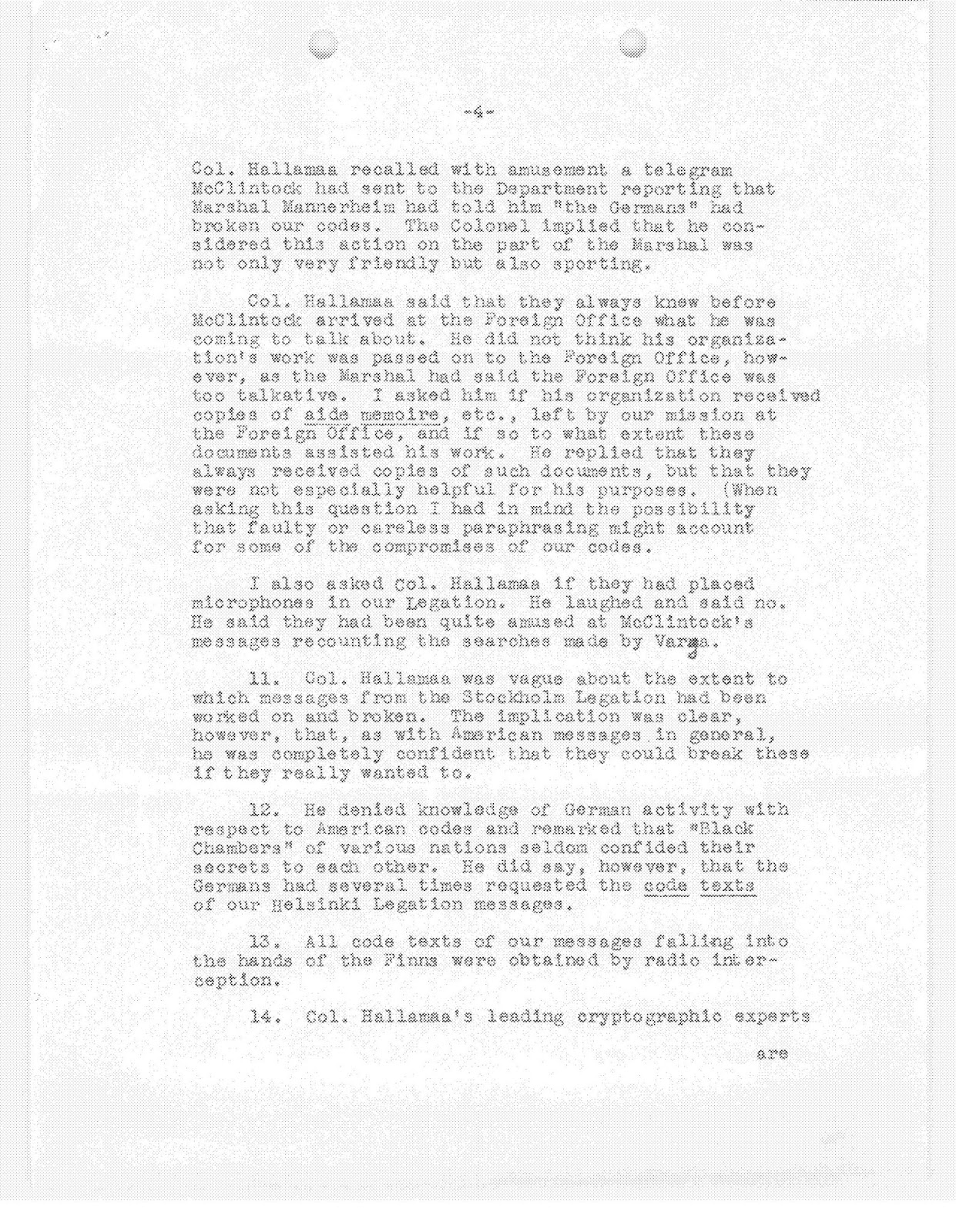

Higgs met
with colonel Hallamaa on September 29 and the OSS officials Tikander and Cole
were also present during their discussion.
Hallamaa
stated that he was an administrator, not a cryptanalyst and about 10-12 of his men
worked on US diplomatic codes.
His unit had
solved the US codes Gray, Brown, M-138-A strip cipher and enciphered codebooks
(probably the A1, B1, C1).
The high
level M-138-A system had been solved mostly by taking advantage of operator
mistakes such as sending strip cipher information on other systems that had already
been broken or sending the same message in different strips one of which had
been broken.
The strip
cipher was considered a strong encryption system and had been adopted by the
Finns for some of their traffic.
Important
diplomatic messages from the US embassies in Switzerland, Sweden and Finland
were read by the Finnish codebreakers.
Regarding Bern, Switzerland most of the
messages dealt with intelligence matters:
‘Replying to my request for information
regarding the contents of the messages from our Legation in Bern to the
Department, Col. Hallamaa said the great bulk of them were intelligence
messages dealing with conditions in Germany, France, Italy and the Balkans. He
spoke in complimentary terms about ‘Harrison’s’ information service’.
Regarding
Helsinki, Finland Hallamaa stated that thanks to the decoded diplomatic traffic
they were always informed of current US policy initiatives:
‘Col. Hallamaa said that they always knew
before McClintock arrived at the Foreign Office what he was coming to talk about’.
Hallamaa
revealed a lot of confidential information to the Americans and volunteered to
have some of his experts interviewed.
The interview was conducted on friendly
terms with Higgs stating; ‘Col. Hallamaa
was most pleasant and seemed to be entirely frank and open regarding the
matters discussed’.
Additional
information: In
November 1944 the US cryptanalysts Paavo Carlson of the Army’s Signal
Security Agency and Paul E. Goldsberry of the State
Department’s cipher unit interviewed Finnish officials regarding their work
on US codes. Their report can be found here.
Monday, April 30, 2018
Article on Chinese codes and ciphers
Interesting
article from the journal Cryptologia: ‘Chinese
cryptography: The Chinese Nationalist Party and intelligence management,
1927–1949’ by Ulug Kuzuoglu.
ABSTRACT
This paper is the first scholarly
attempt to examine the history of Chinese cryptography and the role it played
in building the intelligence network of the Chinese Nationalist Party (KMT)
from 1927 to 1949. Rather than investigating the institutional structure of
intelligence, I focus on Chinese characters, the primary medium that made
cryptology and intelligence possible. Given that the Chinese writing system is
by nature nonalphabetic and thus noncipherable, how did cryptography work in
Chinese? How did the state and its scientists reengineer Chinese characters for
the purposes of secret communication? This paper argues that due to the Chinese
writing system itself, Chinese cryptography was bound to the use of codebooks
rather than ciphers; thus, “codebook management” was central to building
intelligence networks in China.
Wednesday, April 11, 2018
Another dead end?
Last month i posted
the recently declassified Carlson-Goldsberry
report. A memo included in the report had the following handwritten notes: RG 84 box 1 and an NND number that looks
like 857570 or 857560.


This seems to
lead to US National Archives collection RG 84 ‘Records of Foreign Service Posts of the Department of State’.
The NND
number doesn’t seem to be 857570 because that code is associated with reports
of the ‘Supreme
Headquarters Allied Expeditionary Force. Office of the U.S. Political Officer.
2/13/1944-ca. 9/2/1944’.
Other
combinations such as 851510, 857510, 851570 are not valid.
This leaves
NND 857560. This code tracks to RG
84 ‘Sweden’ - Entry 3198 ‘Top
Secret General Records, 1944 – 1952’.
This makes
sense as that report was sent from the US embassy in Sweden.
Box 1 of
entry 3198 says ‘Telegrams
Sent and Received Relating to Finland, 1943-1945’.
One would expect to
find the Carlson-Goldsberry report there.
So when I told
my researcher to check this box I expected that I would be able to get the
reports sent from Sweden in late 1944 summarizing the talks US officials had with
the Finnish
codebreakers.
Unfortunately
both my researcher and the NARA FOIA office have confirmed that these reports are
not there!
So why does
the note say RG 84 box 1 NND 857560?
I’ve asked
the NSA FOIA office if they can give me more information on where they got this
document. If they respond maybe I will be able to track down similar reports in
NARA.
Update: Unfortunately the response from the NSA FOIA office was ‘….we have no additional information to provide’.
Update: Unfortunately the response from the NSA FOIA office was ‘….we have no additional information to provide’.
Tuesday, March 27, 2018
Monday, March 26, 2018
The Carlson-Goldsberry report - Compromise of State Department communications by the Finnish codebreakers in WWII
During WWII
the US State Department used several cryptosystems in order to protect its
radio communications from the Axis powers. For low level messages the
unenciphered Gray and Brown codebooks were used. For important
messages four different codebooks (A1,
B1, C1, D1) enciphered with substitution tables were available.


Their most
modern and (in theory) secure system was the M-138-A
strip cipher. Unfortunately for the Americans this system
was compromised and diplomatic messages were read by the Germans, Finns,
Japanese, Italians and Hungarians. The strip
cipher carried the most important diplomatic traffic of the United States
(at least until mid/late 1944) and by reading these messages the Axis powers
gained insights into global US policy.
Germans,
Finns and Japanese cooperated on the solution of the strip cipher. In 1941
the Japanese gave to the Germans alphabet strips and numerical keys that they
had copied from a US consulate in 1939 and these were passed on by the Germans
to their Finnish allies in 1942. Then in 1943 the Finns started sharing their
results with Japan.
Finnish
solution of State Department cryptosystems
During WWII
the Finnish
signal intelligence service worked mostly on Soviet military and NKVD
cryptosystems however they did have a small diplomatic section located in Mikkeli. This department had
about 38 analysts, with the majority working on US codes.
Head of the
department was Mary Grashorn. Other important people were Pentti Aalto
(effective head of the US section) and the experts on the M-138 strip cipher Karl Erik Henriksson and
Kalevi Loimaranta.
Their main
wartime success was the solution of the State Department’s M-138-A cipher. The
solution of this high level system gave them access to important diplomatic
messages from US embassies in Europe and around the world.
Apart from purely diplomatic
traffic they were also able to read messages of other US agencies that used
State department cryptosystems, such as the OSS
-Office of Strategic Services Bern station, Military
Attaché in Switzerland, Office
of War Information representative in Switzerland, the
Foreign Economic Administration, War Shipping Administration, Office of
Lend-Lease Administration and the War Refugee Board.
Operation
Stella Polaris
In September
1944 Finland signed an armistice with the Soviet Union. The people in charge of
the Finnish signal intelligence service anticipated this move and fearing a
Soviet takeover of the country had taken measures to relocate the radio service
to Sweden. This operation was called Stella Polaris (Polar Star).
In late
September roughly 700 people, comprising members of the intelligence services
and their families were transported by ship to Sweden. The Finns had come to an
agreement with the Swedish intelligence service that their people would be
allowed to stay and in return the Swedes would get the Finnish crypto archives
and their radio equipment. At the same time colonel Hallamaa, head of the
signals intelligence service, gathered funds for the Stella Polaris group by
selling the solved codes in the Finnish archives to the Americans, British and
Japanese.
The Stella Polaris operation was dependent on secrecy. However the
open market for Soviet codes made the Swedish government uneasy. In the end
most of the Finnish personnel chose to return to Finland, since the feared
Soviet takeover did not materialize.
The
American reaction and the Carlson-Goldsberry report
According to
the NSA study History
of Venona (Ft. George G. Meade: Center for Cryptologic
History, 1995), it was at that time that the Finns revealed to the US
authorities that they had solved their diplomatic codes. On 29 September 1944 colonel Hallamaa met
with L. Randolph Higgs of the US embassy in Stockholm and told him about their
success.

In response
two cryptanalysts were sent from the US to evaluate the compromise of US codes
in more detail. They were Paavo Carlson of the Army’s Signal Security Agency
and Paul E. Goldsberry of the State
Department’s cipher unit. Their report dated 23 November 1944 had details
on the solution of US systems.

The
Carlson-Goldsberry report
Unfortunately
locating this report proved to be quite a problem. Initially I searched for
it in the US National Archives (both in the NSA and OSS collections) but
without success.
Thankfully
the NSA FOIA/MDR office has managed to locate this file and they have finally
declassified it.


The 4-page report
summarizes the information gathered by US officials from their interviews of Finnish
codebreakers in 16, 18 and 21 November 1944.
From the
Finnish side Erkki Pale (head of the department working on Soviet ciphers) and Kalevi
Loimaranta (member of the department dealing with foreign diplomatic codes)
gave a summary of their work on various cryptosystems.
The Finns admitted
to solving US diplomatic systems, both codebooks and the strip cipher M-138-A. According
to them an unenciphered codebook could be reconstructed in 6 months but an
enciphered one was harder to solve.
Regarding the
M-138-A cipher it was solved because the alphabet strips were used for long
periods of time, the same strips were used by several users and the numerical
keys were the same for all users. Stereotypical beginnings and endings were
also exploited in assumed plaintext cryptanalytic attacks.
There was
cooperation with the German codebreakers on US systems and the Finns received a
lot of intercepts from them.
The Finnish
codebreakers also used a number of IBM machines for statistical work.
Although the
Finns stated that after the introduction of channel elimination in January 1944
they could no longer solve strip cipher traffic a memo included in the report says
that their detailed knowledge of channel elimination procedures may indicate continued
success with the M-138-A system.

Acknowledgments: I have to thank my friends in the US
for requesting this file from the NSA FOIA/MDR office and getting it
declassified.
Tuesday, March 6, 2018
Bye bye mr Hayashi
In 2017 I tried
to locate a file in the US national archives called ‘Interrogation of mr Hayashi’.
According to the NSA FOIA office it
had been recently transferred to NARA as part of transfer group TR-457-2016-0009.
The reference I was given by NARA pointed to 36 boxes that have not been
indexed, so the file could not be located by my researcher.
I tried to find
the Hayashi file again this year by asking NARA’s research department if they
could locate it but I was told that ‘We
have carefully searched our holdings with a particular focus on Record Group
457 - Entry P4…….however, we were not able to locate the file’.
Thus it seems
that this is the end of my quest for the Hayashi file.
Friday, December 1, 2017
Compromise of State Department communications in WWII
In the course of WWII both the Allies and the Axis powers
were able to gain information of great value from reading their enemies secret
communications. In Britain the codebreakers of Bletchley Park solved several
enemy systems with the most important ones being the German Enigma and Tunny cipher
machines and the Italian C-38m.
Codebreaking played a role in the Battle of the Atlantic, the North Africa
Campaign and the Normandy invasion.
In the United States the Army and Navy codebreakers
solved many Japanese cryptosystems and used this advantage in battle. The great
victory at Midway would probably not
have been possible if the Americans had not solved the Japanese Navy’s JN25 code.
On the other side of the hill the codebreakers of
Germany, Japan, Italy and Finland also
solved many important enemy cryptosystems both military and diplomatic. The
German codebreakers could eavesdrop on the radio-telephone conversations of
Franklin Roosevelt and Winston Churchill,
they could decode the messages of the British and US Navies
during their convoy operations in the Atlantic and
together with the Japanese and Finns they could solve State Department messages
(both low and high level) from embassies around
the world.
Britain, the Soviet Union and the United States did not
have impenetrable codes. In the course of WWII all three suffered setbacks from
their compromised communications. One of the worst failures of US crypto
security was the extensive compromise of State Department communications in the
period 1940-44.
Subscribe to:
Posts (Atom)